Freeze-dried fruit can absolutely be a healthy snack choice, but it is not healthy by default just because the packet says “fruit”. The short answer is that plain freeze-dried fruit usually keeps much of the original fibre and many of the minerals, and it can be a handy way to keep fruit on hand. The catch is portion size. Once the water has gone, it becomes very easy to eat a lot of fruit very quickly.
So, is freeze-dried fruit healthy? Often, yes, especially when it is simply fruit with nothing added. But the real answer depends on what has been done to it, how much you are eating, and what you are comparing it with. A handful of plain freeze-dried strawberries is a very different snack from a sweetened fruit bite with coatings, syrups or fruit juice concentrates.
What freeze-dried fruit is and why people see it as healthy
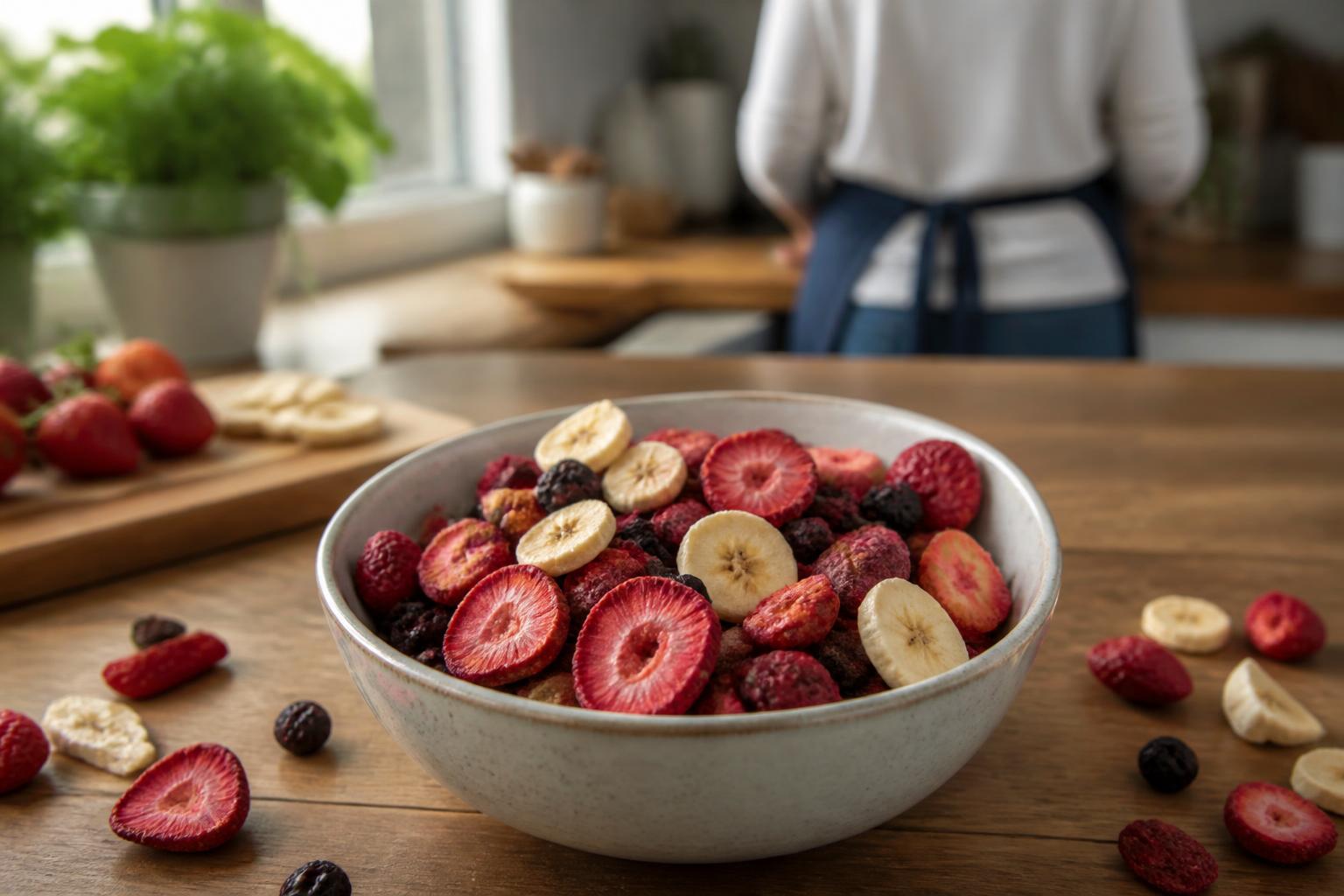
Freeze-drying is a preservation method that removes water from food while keeping much of its original shape, colour and flavour. The fruit is first frozen, then placed under low pressure so the ice turns straight into vapour rather than melting into liquid first. That process is why freeze-dried fruit often looks like a puffed-up version of the fresh fruit it came from, rather than the leathery, chewy result you get with conventional dried fruit.
The texture is a big part of the appeal. Freeze-dried fruit is light, crisp and brittle. It shatters, crunches and melts down quickly in the mouth. For people who want something sweet but not sticky, that can feel far more snack-like than fresh berries or a tub of chopped melon.
Shelf life is another reason people reach for it. With most of the water removed, plain freeze-dried fruit is less perishable than fresh fruit and easier to keep in a cupboard, desk drawer or bag. That convenience matters in real life. A punnet of raspberries can turn within days. A sealed pouch of freeze-dried raspberries can sit there until you actually need it.
People also see it as healthy because it often has a short ingredients list. In the best cases, it is exactly what it says on the front, apple, strawberry, banana, mango. No frying, no syrup, no obvious extras. It can also feel less “processed” than some bars, bites and fruit-flavoured snacks, even though freeze-drying is still a processing method.
That is where the health question gets more interesting. “Processed” is not a useful verdict on its own. Chopping, freezing and pasteurising are all forms of processing too. What matters more is what the process changes. In freeze-dried fruit, the biggest change is the loss of water. That affects texture, storage, and how quickly a portion can disappear.
A bowl of fresh strawberries contains plenty of water and takes up space. The freeze-dried version is tiny by comparison. That means the fruit’s natural sugars are not higher per gram of original fruit, but they are more concentrated in the food as you eat it. You can get through the equivalent of a generous serving of fruit in a few crunchy mouthfuls, and still feel like you have barely had a snack.
If you like this kind of reality check, our piece on freeze-dried fruit without the health halo goes deeper into the gap between the wholesome image and the practical nutrition.
Does freeze-drying keep the nutrients?
Mostly, freeze-drying does a decent job of preserving nutrients, especially compared with some harsher food processing methods. Fibre is generally retained because the fruit’s structure is still there, just without the water. Minerals such as potassium are also usually quite stable.
That matters because fibre is one of the reasons fruit is a different nutritional package from sweets. Even when freeze-dried fruit tastes concentrated and sweet, plain versions still bring fibre with them. That can make them a better choice than many fruit-flavoured snacks that mainly deliver sugar and starch.
Vitamins are where things get less tidy. Some vitamins are more sensitive to oxygen, light and heat than others. Vitamin C is the classic example. Freeze-drying tends to be gentler than high-heat drying, but that does not mean vitamin C is perfectly preserved forever. Losses can happen during processing, storage and handling, especially if the pack is opened and not resealed well.
Fat-soluble vitamins are less central for most fruits, but where present they may be more stable. Folate and some antioxidant compounds can also be affected to varying degrees depending on the fruit, the exact process, and how long the product sits on the shelf.
So the evidence is strongest on the basics. Plain freeze-dried fruit usually keeps fibre. It usually keeps many minerals. It often keeps a good share of its plant compounds. But it is not identical to fresh fruit, and it is not sensible to assume every vitamin survives untouched.
Storage matters more than many shoppers realise. A packet that protects the fruit from moisture, oxygen and light gives it a better chance of holding onto quality. Once opened, crisp fruit can go soft and nutrient losses can continue. That does not make it “bad”, but it is one reason to buy a size you will actually finish.
It is also worth separating whole freeze-dried fruit from products made with freeze-dried fruit. A cereal cluster with a dusting of freeze-dried raspberry powder is not nutritionally the same thing as a bag of freeze-dried raspberries. The ingredient can be useful and flavourful, but the overall food still needs judging as a whole. We look at that in more detail in how freeze-dried fruit powder fits into everyday snacks.
In short, freeze-drying can preserve a lot, but not everything. If your benchmark is fresh fruit eaten at its best, fresh still has advantages. If your benchmark is a fruit snack with added sugar and little fibre, plain freeze-dried fruit often comes out looking strong.
How it compares with fresh, dried and tinned fruit
The simplest way to compare fruit formats is to start with water. Fresh fruit contains lots of it. Freeze-dried fruit contains very little. Conventional dried fruit, such as raisins, apricots or dates, also has much less water than fresh fruit, but it tends to be chewy and dense rather than crisp. Tinned fruit sits somewhere else entirely, preserved in liquid.
That difference in water changes almost everything about the eating experience.
Fresh fruit is usually the most filling for its size because the water adds bulk. An apple takes time to chew. A bowl of berries looks generous. You get sweetness, fibre and fluid all in one go. For many people, that makes fresh fruit easier to portion naturally.
Freeze-dried fruit is much lighter and smaller. It can be wonderfully convenient, but it is less physically filling than the fresh equivalent. A few slices of freeze-dried banana can vanish at the speed of crisps. That does not make it unhealthy, but it does mean satiety can be lower than people expect.
Conventional dried fruit is often even more concentrated and sticky. It can be a useful source of energy, but it is easy to overeat for the same reason. It also clings to teeth more than crisp freeze-dried fruit, which is worth noting if you are thinking about dental habits, especially for children’s lunchboxes.
Tinned fruit is practical in a different way. It is soft, ready to eat and usually budget-friendly. In the UK, it is worth checking whether it is tinned in juice or in syrup. Fruit in juice is generally the simpler choice. Syrup adds extra sugar that was not naturally part of the fruit. Draining the liquid helps, but it does not turn syrup-packed fruit into the same thing as fruit in juice.
For UK shoppers, nutrition labels are generally clear enough to compare these formats directly. Ingredients are listed in descending order by weight, and added sugars must appear in the ingredients list if used. Unlike some broader EU discussions around front-of-pack systems, what matters most here is still the back of pack detail. A pouch of “fruit crisps” may sound virtuous, but the ingredients panel tells you whether it is just fruit or something more dressed up.
Portion size is where freeze-dried fruit can catch people out. Because it is airy and light, a serving can look modest. But that little handful may represent quite a lot of original fruit. If you are using it as a topping on porridge or yoghurt, that can be brilliant. If you are eating straight from a family-sized pouch while answering emails, less so.
Fresh fruit still wins on hydration and often on fullness. Freeze-dried fruit wins on cupboard life, portability and crunch. Conventional dried fruit wins on density and energy for small spaces, useful for walking, travel or emergency snacks. Tinned fruit wins on convenience at home and can be a very practical standby.
None of these formats is automatically the “best” one. The better question is which one fits the situation without nudging you into eating more than you meant to.
When freeze-dried fruit can be a smart snack
Freeze-dried fruit earns its place when fresh fruit is awkward, fragile or likely to be forgotten in the bottom drawer of the fridge.
Lunchboxes are an obvious example. Fresh berries can get squashed. Banana goes brown. A small portion of plain freeze-dried fruit stays neat, dry and easy to pack. It also adds crunch, which can make a lunch feel more satisfying. That said, it is often best used as one part of a snack rather than the whole thing. Pairing it with yoghurt, nuts or a cheese portion usually gives you a more balanced result.
It is also useful in cupboards for those “there is nothing in” moments. Keeping a pack of freeze-dried fruit in the kitchen can stop the slide into random biscuits or whatever is lurking in the snack tin. We often find that practical, low-friction options matter more than perfect intentions, which is why we talk a lot about healthy habits that actually fit a busy UK day.
Travel is another strong use case. Freeze-dried fruit is light, not messy, and usually fine to carry around for hours. On trains, in the car, or in a work bag, it is far easier to manage than a peach, a punnet of grapes or a pot of pineapple.
It can also work well as part of a snack board or desk snack when you want sweetness without heading straight for confectionery. The crunch gives it a different kind of satisfaction from soft fruit. That sensory side matters. People do not snack on nutrients. They snack on textures, habits and what is easy to grab.
Where we would be more cautious is using freeze-dried fruit as a free-for-all “healthy” nibble. If a food feels virtuous, it is easy to stop paying attention to quantity. A large bag can disappear surprisingly quickly, and because the fruit is so light, it may not register as much food in the moment.
It is also not always the best choice if you need a snack that truly keeps hunger down for hours. Fruit alone, whether fresh or freeze-dried, may not do that for everyone. A more satisfying option might combine fruit with protein or fat, such as Greek yoghurt, nuts or seeds. If that is your usual sticking point, our guide to healthy snack ideas for adults that actually fit real days covers combinations that hold up better between meals.
So yes, freeze-dried fruit can be a smart snack. It is just smartest when used deliberately, not when it is standing in for every other form of fruit or being treated as nutritionally untouchable.
What to check on the pack before you buy
The front of the pack is often all sunshine, orchards and cheerful claims. Turn it over.
First, check the ingredients list. For plain freeze-dried fruit, the ideal list is wonderfully boring. It should say the fruit, and that is about it. Strawberries. Apples. Mango. If you start seeing sugar, glucose syrup, fruit juice concentrates used as sweeteners, oils, flavourings or coatings, you are no longer looking at simple freeze-dried fruit.
Second, look at the product name carefully. “Freeze-dried fruit” is not the same thing as “fruit snack”, “fruit bites” or “fruit crisps”. Those broader names can cover all sorts of formulations. Some are still decent choices, but they are different products and should be judged on their own labels.
Third, check the nutrition panel per 100g and per serving. Per 100g figures for sugars can look startling, but remember the water has been removed. That comparison is not always as dramatic as it first appears once you think about the fresh equivalent. More useful is the serving size. Ask yourself whether the stated portion is realistic for how you actually eat.
Fourth, watch for coatings. Chocolate, yoghurt-style coatings and sweet glazes can turn freeze-dried fruit into more of a confectionery hybrid. Nothing wrong with that if that is what you want, but it is not the same as buying plain fruit.
Fifth, notice whether the packet is resealable. This is not a nutrition issue exactly, but it matters. A resealable pack helps with portion control and keeps the fruit crisp after opening. If it goes soft, people often eat it quickly just to use it up.
If you are shopping for children, the same checks apply. Packaging can make products look child-friendly and fruit-forward while the ingredients tell a more complicated story. In the UK, labels must still list ingredients clearly, so use that to your advantage.
Finally, be realistic about your own habits. If you know you are likely to eat the whole pouch in one sitting, buy smaller packs or portion some into a bowl. If you tend to snack better when there is crunch involved, freeze-dried fruit may be genuinely useful. If you prefer something more filling, it may be better as a topper than a standalone snack.
The bottom line is simple. Freeze-dried fruit can be healthy, especially when it is plain fruit with no extras. It keeps many of the good things people want from fruit, and it solves a real-life convenience problem. But it is not magic, and it is not a nutritional copy-and-paste of fresh fruit. Read the pack, watch the portion, and treat it as one practical option in the snack cupboard, not a halo in a pouch.

Questions about this article or a correction to suggest? Get in touch. Read more about our editorial approach.