Freeze-dried fruit in the UK is exactly what it sounds like, fruit that has had its water removed after being frozen, so it turns up crisp rather than sticky or leathery. It can be useful, convenient and genuinely enjoyable to eat, but it is not magic. It is still fruit, just in a much lighter, more concentrated form, which means the same handful can represent more fruit, and more sugar, than it looks like at first glance.
That is why the sensible view sits somewhere between two extremes. Freeze-dried fruit is not the same as fresh fruit, and it is not automatically a “healthy” snack just because the packet uses clean design and mentions berries. But it can be a practical cupboard ingredient, a lunchbox extra, or a crunchy topper when you know what you are buying and how much you are actually eating.
What freeze-dried fruit actually is
Freeze-drying starts with fruit that is frozen solid. Once frozen, it goes into a low pressure environment so the ice inside the fruit can turn straight into vapour without becoming liquid water first. The technical term matters less than the result, the water leaves while much of the fruit’s original shape stays behind.
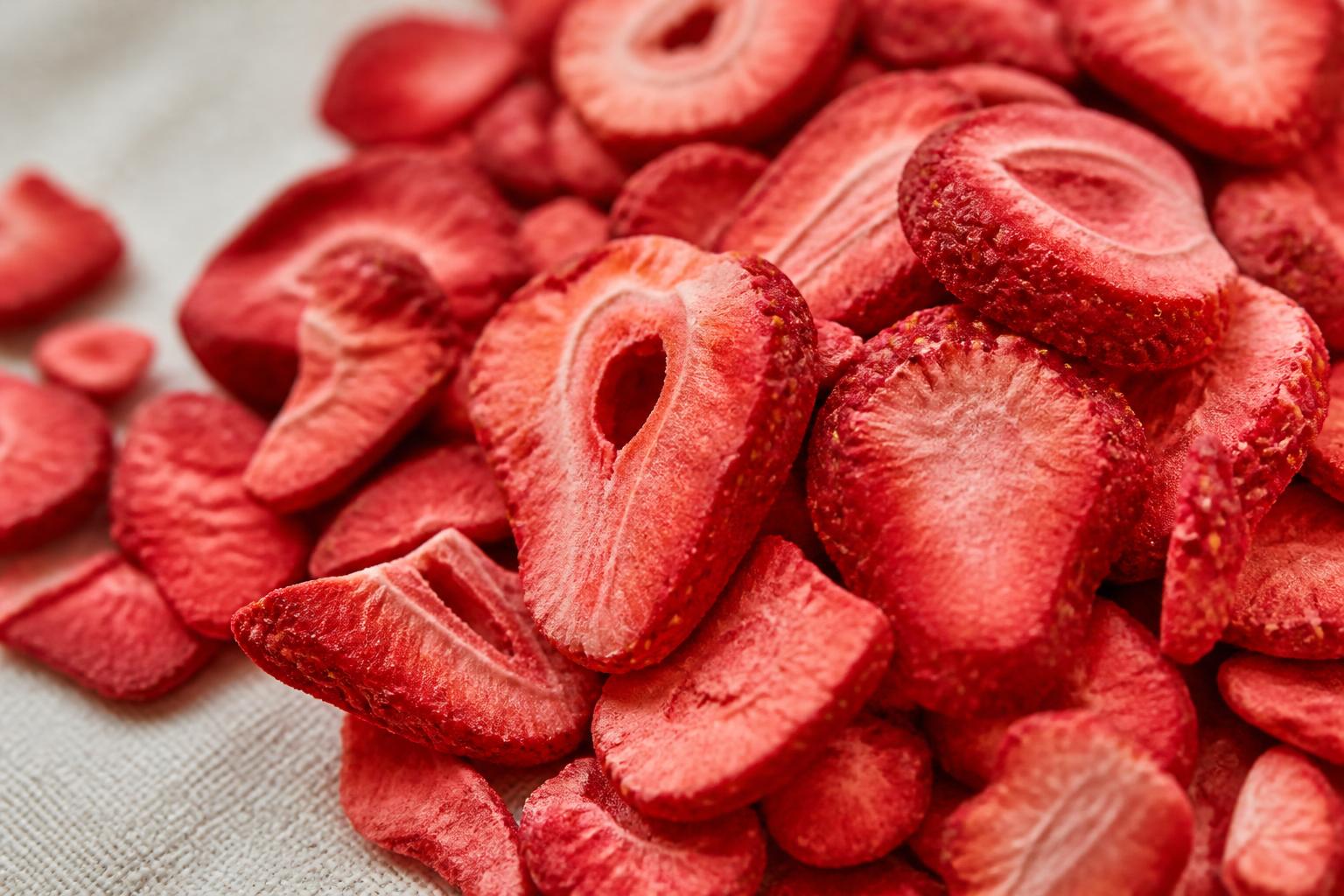
That is the reason the texture is so distinctive. With ordinary dried fruit, water is removed more slowly, often with heat, so the fruit collapses and becomes dense, bendy or chewy. With freeze-drying, the frozen water leaves tiny gaps behind in the structure. Those gaps make the fruit light, brittle and airy. Bite into a freeze-dried strawberry slice and it tends to snap or crumble. Bite into a standard dried apricot and it pulls back.
It also explains why freeze-dried fruit feels almost weightless in the hand. A punnet of fresh raspberries contains plenty of water. A bag of freeze-dried raspberries contains the same fruit matter with most of that water gone, so the volume can look generous while the weight on the front of pack stays low.
In the UK, this format shows up in several forms. Whole berries, sliced banana, apple pieces, mango chunks and mixed berry powders are common. Some are sold as ingredients for baking or breakfast bowls. Others are marketed as snacks. The process is the same, but what matters to us as shoppers is what else has been added afterwards, if anything.
How it compares with fresh and dried fruit
The biggest practical difference between fresh fruit and freeze-dried fruit is water content. Fresh fruit is mostly water. Freeze-dried fruit has had nearly all of that removed. That changes everything from the crunch to the shelf life.
Fresh fruit is juicy, perishable and often messy to carry around. It bruises, leaks, goes soft, and usually wants to be eaten within days. Freeze-dried fruit is dry, crisp and far more stable at room temperature while sealed. It is easy to keep in a cupboard, take to work, or scatter over breakfast without peeling, chopping or washing.
Compared with standard dried fruit, freeze-dried fruit is usually lighter and crisper. Raisins, dates and dried mango tend to be chewy because they still contain more moisture than freeze-dried fruit. They can also feel stickier and sweeter in a more obvious way. Freeze-dried fruit often tastes sharper and more intense because the flavour is concentrated but the texture is dry and brittle rather than syrupy.
Shelf life is another clear difference. Fresh fruit has the shortest window by far. Freeze-dried fruit usually lasts much longer while unopened, provided it is kept dry. Once opened, texture becomes the weak point. Leave it exposed to air and humidity, and that prized crispness can disappear quickly. It starts pulling in moisture from the room and becomes softer or stale. A resealable pouch helps, but only if you actually press the air out and close it properly.
Concentration is where people can get caught out. Because the water has gone, the fruit becomes much smaller and lighter for the same original amount. A small handful of freeze-dried apple can represent more apple than it appears to. That is not a problem in itself, but it does mean it is easy to eat quite a lot without noticing. The texture encourages nibbling, and the portion can look modest even when it is nutritionally equivalent to a much larger pile of fresh fruit.
There is also a practical difference in how it behaves in food. Fresh fruit adds moisture. Freeze-dried fruit removes it. Stir fresh berries into yoghurt and they soften the bowl. Stir freeze-dried berries into yoghurt and they keep a little crunch at first, then gradually absorb moisture. In baking, this can be useful. Freeze-dried fruit can bring flavour without watering down a sponge, buttercream or biscuit dough.
Is freeze-dried fruit healthy?
The sensible answer is, it depends on the product and the portion.
If a pack contains 100% fruit and nothing else, freeze-dried fruit still brings many of the things people want from fruit, including fibre. It also usually contains the fruit’s naturally occurring sugars. What it does not bring is the water that helps make fresh fruit filling and self-limiting. So yes, it can fit into a healthy diet, but no, it is not a free pass to eat the whole bag while answering emails.
This is where the health halo creeps in. Freeze-dried fruit often looks virtuous. It is colourful, light, sold in minimalist pouches, and frequently placed near breakfast toppings or children’s snacks rather than confectionery. That presentation can make it seem less energy-dense than it really is. But once fruit is concentrated, the sugars become concentrated too. They are still naturally present sugars if nothing has been added, but your mouth and appetite may not register the amount in the same way as they would with fresh fruit.
Fibre is one of the more useful positives. A plain freeze-dried fruit product can still contribute fibre, which is one reason it can be more satisfying than a sugary sweet or fruit-flavoured crisp with little actual fruit in it. But fibre alone does not cancel everything else out. If the fruit has been coated in chocolate, yoghurt-style coatings, syrups or extra sugar, you are no longer looking at just fruit in a different format.
Portion size matters more than many shoppers realise. A bowl of fresh strawberries looks substantial because of the water. The freeze-dried equivalent can look like a polite scattering. That can lead to automatic refills. It is worth deciding whether you are using it as a garnish, an ingredient, or a snack in its own right, because the amount that makes sense changes with the role.
There is also a UK point worth keeping clear. On-pack claims are regulated, and brands cannot simply say whatever they like about health. But broad cues such as “natural”, “nothing artificial” or pictures of whole fruit can still create a healthier impression than the nutrition panel justifies. That is why the back of pack matters more than the front.
If you are trying to keep everyday choices balanced, freeze-dried fruit often works best when it is part of something rather than the whole plan. Mixed into porridge, added to plain yoghurt, or used in a homemade trail mix with nuts and seeds, it can bring flavour and crunch without taking over. If you are specifically trying to keep sugar in check, our guide on how to pick low-sugar snacks that still feel satisfying is the more useful lens than any front-of-pack wellness language.
How to read UK packs and ingredient lists
Start with the ingredient list. If it says “strawberry” or “banana” and little else, you know where you stand. If it says sugar, glucose syrup, fruit juice concentrate, vegetable oil, flavourings, coating, or anything that sounds more like confectionery than fruit, pause there. Freeze-dried fruit can be sold plain, but it can also be turned into a sweet snack that only borrows fruit’s good reputation.
Look at the product name as well as the picture. “Freeze-dried strawberry pieces” suggests one thing. “Strawberry bites”, “berry crunch”, or “fruit snacks” can mean something broader. In UK retail, the front of pack can be visually fruity while the ingredient list tells a different story.
Check whether it is 100% fruit. That phrase is not everything, but it is a useful first filter. If the product is aimed at children, this matters even more, because smaller packs can make sweetened products look modest and harmless.
Then check the nutrition panel per 100g and per serving. Per 100g gives you the fairest comparison across products. Per serving can be helpful, but only if the serving is realistic. This is where freeze dried fruit in the UK can get slippery. A serving size may be very small because the product is light and concentrated. On paper, that can make the sugar and calories look low. In real life, many people will eat more than that serving without thinking.
If the packet contains several servings, ask yourself whether you would ever stop at one. If the honest answer is no, the per pack view matters more. This is especially useful with resealable pouches, where “serving size” can quietly mean “the amount the brand wishes you would eat”, not “the amount most people actually eat”.
For coated products, look carefully at the order of ingredients. Ingredients are listed by weight. If sugar or coating ingredients appear before the fruit, the fruit may be there more as a theme than as the main event.
If you are comparing UK packs with products sold elsewhere, remember labelling can differ. Since the UK is no longer in the EU, some packaging rules and presentation details are no longer identical, even though much of the practical information shoppers use still looks familiar. The safest habit is simple, read the actual pack in front of you rather than assuming a product sold online or abroad follows the same format.
It also helps to distinguish between freeze-dried fruit pieces and freeze-dried fruit powder. Powders can be useful in smoothies, icing or porridge, but they are even easier to overuse because they disappear into the food. You lose the visual cue that tells you how much fruit you have added.
Where freeze-dried fruit fits in everyday snacks
This is where freeze-dried fruit earns its keep, not as a saintly super-snack, but as a practical ingredient with a very specific texture.
At breakfast, it works well where fresh fruit would make things soggy or where you want fruit on hand without worrying about waste. A spoonful over porridge, granola or plain yoghurt adds crunch and a sharp burst of flavour. It is especially handy midweek, when the fresh berries you bought with good intentions have already gone soft in the fridge.
In cereal, use it as a topper rather than assuming the cereal itself contains enough fruit to count for much. Many cereals include tiny fruit pieces for appearance. Adding your own lets you control both flavour and quantity. The same applies to overnight oats, although the crunch will soften if left sitting in the mixture.
For baking, freeze-dried fruit is one of the easiest ways to add fruit flavour without extra moisture. Crushed raspberries can be folded into icing sugar for a naturally tart dusting. Strawberry powder can flavour buttercream. Small pieces can go into biscuits, flapjacks or white chocolate bark. Because the fruit is dry, it behaves differently from fresh fruit and will not flood a batter.
In lunchboxes, it is tidy and light, which is why so many people like it. It does not bruise, leak or need a separate spoon. But it is best treated as one element of a fuller snack rather than the entire answer. Pairing it with something more substantial, such as nuts, seeds, crackers or cheese, usually lands better than relying on fruit alone to carry someone through the afternoon. If you are building packed options that actually survive the journey, our guide to crunchy lunch boxes that stay crisp until you eat covers the practical side well.
For on-the-go snacking, freeze-dried fruit is useful precisely because it is dry and portable. It can live in a desk drawer, gym bag or coat pocket more happily than a peach ever will. The main caution is that it is easy to eat absent-mindedly. A few apple crisps while waiting for a train is one thing. Grazing through a whole pouch because it feels feather-light is another.
It also works nicely in homemade mixes. A small amount of freeze-dried fruit can brighten nuts, seeds and roasted pulses with sweetness and sharpness, without turning the whole mix into a sugar-heavy affair. If you like building texture into snacks rather than buying another prepared pouch, our piece on healthy savoury snacks that keep everyday choices simple is a useful counterbalance to sweeter snack habits.
The best role for freeze-dried fruit, then, is not “better than all other snacks”. It is “good at what only it does”. It gives you fruit flavour in a crisp, shelf-stable form that fresh fruit and standard dried fruit do not quite match. Used with open eyes, that is enough. It does not need the health halo to be worth having in the cupboard.

Questions about this article or a correction to suggest? Get in touch. Read more about our editorial approach.