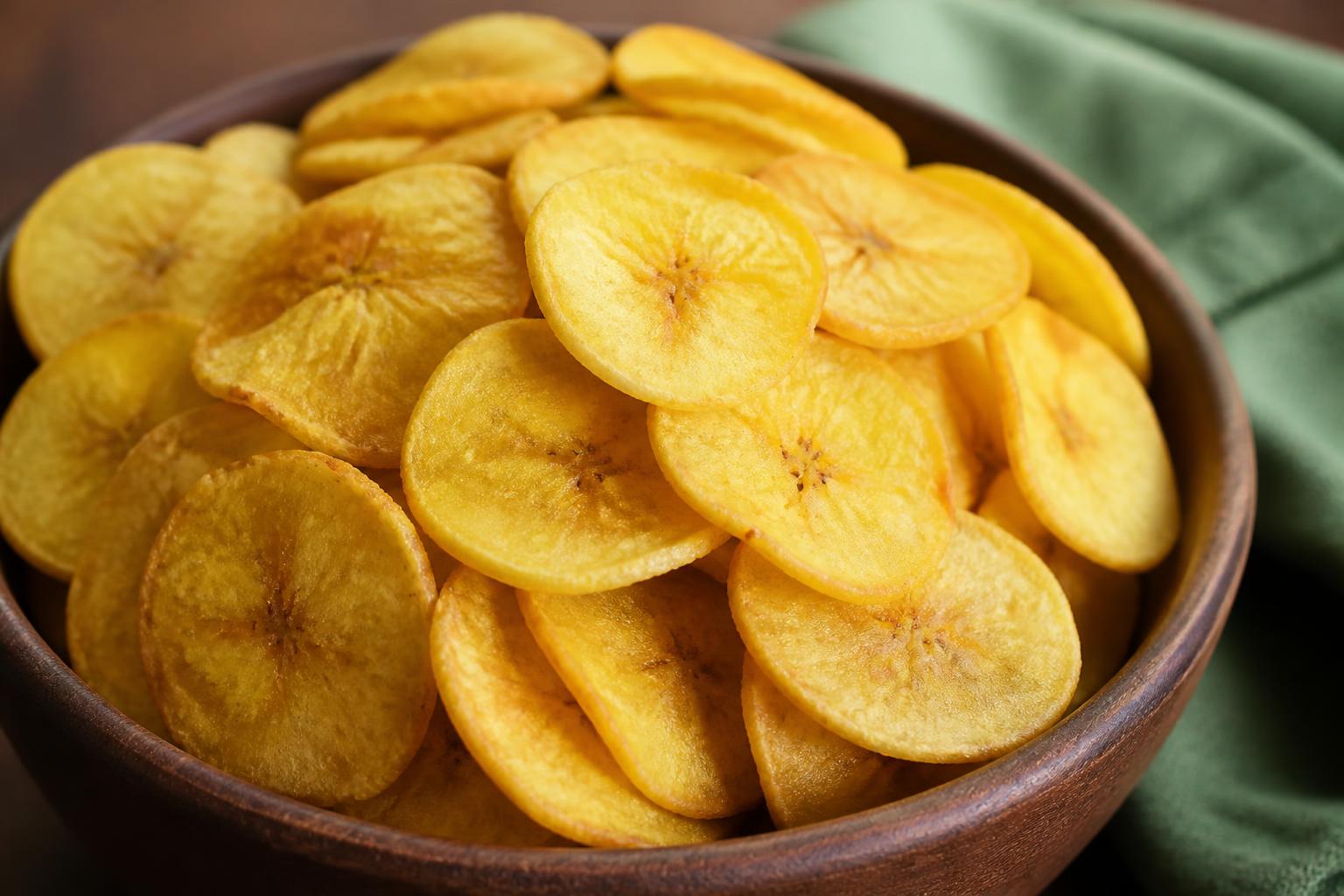
Plantain crisps can be a perfectly reasonable everyday snack, but they are not automatically a healthy one. If you are asking whether plantain crisps are healthy, the honest answer is, sometimes. It depends on what is in the bag, how they are cooked, how salty they are, and whether you treat them as a small crunchy extra or polish off the whole pack without noticing.
They often arrive with a wholesome glow because plantain sounds more natural than potato and the slices look rustic, golden and a bit less factory-made. But a crisp is still a crisp unless the ingredients and nutrition panel give you a better story. Some plantain crisps are simply sliced plantain fried in oil with salt. Others are heavily seasoned, sweetened, or made in a way that pushes fat and salt up fast. So the useful question is not whether plantain crisps are healthy in theory, but which ones are sensible for regular snacking and which ones are just wearing a healthier outfit.
What this article covers that our vegetable crisps piece does not
We have already looked at the broader question in our guide to whether vegetable crisps are a healthy swap for potato crisps. Plantain crisps deserve their own space because they are not just another mixed veg crisp in a colourful sharing bag.
Plantain is a specific ingredient with its own texture, starch profile and cooking behaviour. It does not behave like beetroot, parsnip or sweet potato, and it certainly does not behave like a standard thin potato crisp. That matters because the final snack can vary a lot depending on whether the plantain was green or ripe, sliced lengthways or into coins, fried hard for a shattering crunch or cooked more gently.
Labels can be quirky too. One bag may be little more than plantain, sunflower oil and sea salt. Another may include palm oil, sugar, flavour powders, acidity regulators and yeast extract. Some products are sold as chips, some as crisps, some as “lightly salted plantain slices”, and the front of pack can make them seem simpler than they really are. Looking at plantain crisps as their own category helps us judge them properly, rather than giving them a free pass because they are not made from potato.
What plantain crisps are really made from
Plantains are close relatives of bananas, but in the kitchen they are used very differently. A banana is usually eaten ripe and sweet, soft enough to peel and eat as it is. A plantain is starchier, firmer and more often cooked. Green plantains are particularly starchy and much less sweet, which is why they are commonly used for crisps.
That starch content is a big part of the texture. Slice a green plantain thinly and fry or bake it, and you get a dry, rigid snap rather than the airy crumble of some potato crisps. If the plantain is riper, the natural sugars are higher and the flavour shifts. The crisps may brown more quickly, taste sweeter and sometimes feel a touch denser.
Slicing style matters as well. Thin rounds usually give a neat, brittle crunch. Long diagonal slices can feel more substantial and can hold more seasoning or oil on the surface. Thicker slices may seem more hearty, but they can also carry more fat if they are fried.
The basic ingredient list in a simple bag is short. You are usually looking for plantain, oil and salt. That is the cleanest version. But “simple” does not always mean light. Plantain is still a starchy food, and once it is sliced and fried, the bag can become calorie-dense in the same way many crunchy snacks do.
Cooking method changes the picture further. Fried plantain crisps are the most common. They tend to have the deepest crunch and richest flavour, but also absorb oil. Baked versions exist, though less commonly, and some brands use language such as “hand cooked” or “small batch”, which sounds artisanal but tells you very little about the nutrition on its own. Hand cooked can still mean salty and oily.
This is why the answer to whether plantain crisps are healthy starts with the ingredient itself but cannot end there. Plantain is not nutritionally identical to potato, yet once both are turned into crisps, the gap can narrow quickly.
When plantain crisps can be a sensible choice
Plantain crisps can fit everyday snacking when a few conditions line up.
First, the ingredient list should be straightforward. A bag made from plantain, a reasonably stable oil such as sunflower or rapeseed oil, and a moderate amount of salt is usually a better starting point than one loaded with barbecue flavouring, sugar, maltodextrin and a long tail of additives. A short list does not guarantee a healthy snack, but it usually makes the product easier to assess.
Second, portion size matters more than people expect. Crisps are easy to eat by feel rather than hunger. If you decant a modest serving into a bowl, or choose a genuinely small single-serve pack, plantain crisps can sit quite comfortably alongside lunch or as an afternoon nibble. If you eat from a large sharing bag while answering emails or watching telly, the crunchy rhythm makes overdoing it almost effortless.
Third, frequency matters. Everyday snacking does not have to mean several bags a day. A small portion of plantain crisps now and then, within an overall balanced diet, is very different from relying on them as your default answer whenever you want something savoury. If your daily snack routine is built mostly from crisps, however “natural” they sound, you are likely crowding out foods that offer more protein, fibre or micronutrients for the same calories.
They can also be a useful option for people who want a crunchy savoury snack that is not potato-based. That does not make them superior by default, but it can make them a practical alternative. If you like rotating your snacks, our round-up of healthy snacks you can keep in a desk drawer is worth a look, because the strongest snack routine usually mixes crunchy treats with options that are less easy to overeat.
A sensible everyday plantain crisp, then, is one with a plain ingredient list, moderate salt, no unnecessary sweeteners or heavy flavour dusting, and a portion size you can keep realistic. In that setting, yes, plantain crisps can be healthy enough to earn a regular place. Not as a haloed superfood, but as a decent crunchy snack.
Why the health halo can slip
The halo usually slips for four reasons, oil, salt, flavourings and crunch.
Oil comes first because most plantain crisps are fried. Frying gives them that lovely hard snap and toasted flavour, but it also raises the energy density quickly. A small handful can contain more calories than it looks as though it should. Because the slices are often thicker and firmer than standard potato crisps, they can feel substantial, yet they are still easy to keep reaching for.
Salt is the next issue. Some lightly salted bags are reasonable. Others are punchy enough that you notice the salt on your lips after a few handfuls. In the UK, the nutrition panel will usually list salt per 100g and often per serving too. If the serving size is unrealistically tiny, the per-serving figure can look friendlier than the product really is. That is one reason we always check both.
Flavourings can complicate things further. Sweet chilli, smoky barbecue, jerk seasoning or sticky-sweet variants may sound fun, but they often bring extra sugar, more sodium, and a longer ingredient list. None of that makes the product forbidden. It simply moves it away from the idea of a plain everyday staple.
Then there is the crunch factor. Plantain crisps have a dense, satisfying bite that can make them feel more “proper” than flimsier snacks. That is part of their appeal, but it also makes them easy to overeat. They are salty, crispy and repetitive in exactly the way that encourages mindless nibbling. The bag empties with a surprising lack of drama.
This is where packaging language can mislead. “Gluten free”, “vegan”, “made from real plantain”, or “all natural ingredients” may all be true, but none of them tells you whether the bag is low in salt or moderate in calories. Health-adjacent wording is not the same thing as a healthy everyday choice.
How to compare a bag in 30 seconds
If you are standing in a shop or scrolling online, you can assess a bag of plantain crisps very quickly.
Start with the serving size, then ignore it for a moment and look at the figures per 100g. Per-serving numbers are helpful only if the serving is realistic. A tiny stated portion can make almost any crisp look tame.
Next, check calories. You do not need a magic number, but compare like with like. If one plantain crisp is much higher per 100g than another, it is often carrying more oil.
Then look at saturated fat. In the UK, this appears clearly on the nutrition panel. Lower is generally better for an everyday snack, especially if you eat other processed foods during the day. Coconut oil and palm oil can push saturated fat up, so glance at the ingredient list too.
After that, check salt. This is one of the quickest ways to separate a fairly sensible bag from a sneaky one. A product can seem wholesome and still be heavily salted. If you are choosing between two similar bags, the lower-salt option is often the easier win.
Fibre is worth a glance as well. Plantain crisps may offer some fibre, but this varies and it should not be exaggerated. If a bag gives you a bit more fibre with no big jump in salt or fat, that is useful. It does not turn crisps into a nutritional powerhouse, but it can make one option a better fit than another.
Finally, read the ingredient list. We are looking for a list that makes sense at first glance. Plantain, oil, salt is the cleanest version. A few spices are fine. A long list of flavour carriers, sugars and extracts tells you the product is becoming more of a formulated snack than a simple sliced ingredient.
That same quick label method works across other crunchy snacks too. If you are comparing different formats, our guide to whether popped lotus seeds are a healthy snack choice shows how a very different snack can still be judged by the same practical checks.
One UK-specific point, front-of-pack traffic light labels are common here but not mandatory on every product. If they are present, they can speed things up, especially for fat, saturates and salt. If they are not, the back-of-pack table is still the most reliable place to look. That is more useful than broad EU-level assumptions, because front-of-pack schemes vary across markets and packs sold in the UK may be labelled a little differently from those sold elsewhere.
Where plantain crisps sit next to potato crisps and other crunchy snacks
Plantain crisps are not automatically healthier than potato crisps, but they can be. The only honest way to compare them is bag against bag.
Against standard potato crisps, plantain crisps may sometimes come out better on ingredients if they are simply made and lightly salted. They may also offer a different flavour profile that helps some people feel satisfied with a smaller amount. But they can also be just as high, or higher, in calories and fat if they are heavily fried. The fact that the base ingredient is plantain does not guarantee a nutritional advantage.
Against mixed vegetable crisps, plantain crisps can actually be easier to judge. Mixed vegetable bags often combine roots with very different moisture levels and cooking behaviour, which can produce big swings in oil uptake and sweetness. Plantain, being a single ingredient, is often more consistent. That consistency is useful when you are trying to build an everyday habit rather than buy into marketing.
Against pulse-based snacks, popped seeds, or lentil chips, plantain crisps may lose ground on protein and sometimes on fibre. If your main goal is staying full between meals, those categories may do more work for you. If your main goal is a clean, savoury crunch with a short ingredient list, plantain crisps may still be the one you actually enjoy enough to stick with. Snack choice is not only about the neatest nutrition panel. It is also about whether the portion feels satisfying and realistic in real life.
That is why we resist blanket claims. Plantain crisps can be a better option than potato crisps in some cases, roughly similar in others, and worse in a few. They sit in the middle ground, promising but not magical.
So, are plantain crisps healthy for everyday snacking? They can be, if you choose plain or lightly seasoned bags, keep an eye on salt and saturated fat, and treat them as a portioned snack rather than a bottomless crunchy companion. They are best thought of as a sensible option within a varied snack routine, not as a nutritional loophole. If the bag is short on ingredients and modest on the label, plantain crisps can earn their place. If it is oily, salty and easy to demolish in one sitting, it is still a treat wearing a tropical badge.

Questions about this article or a correction to suggest? Get in touch. Read more about our editorial approach.