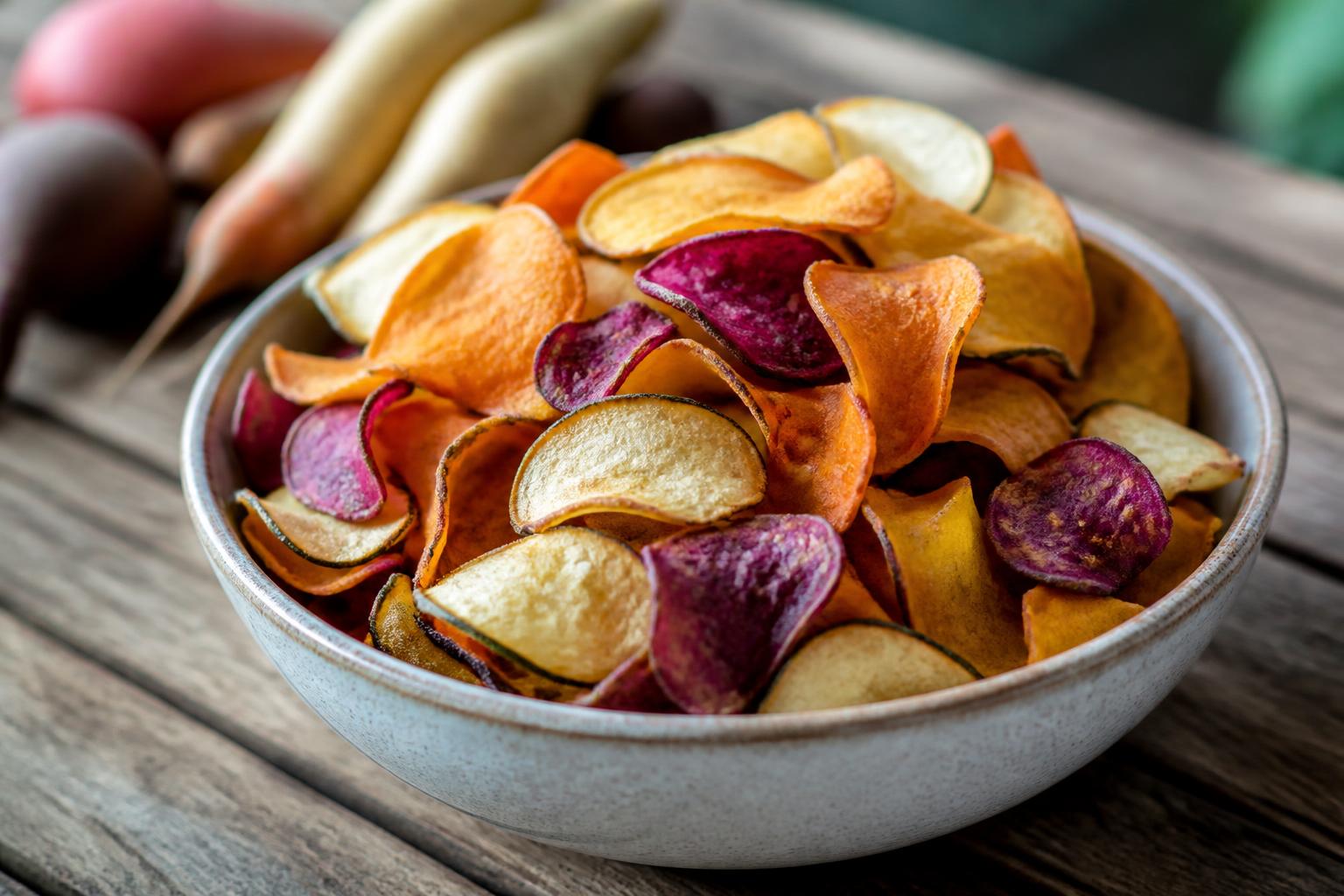
Vegetable crisps can be a perfectly enjoyable snack, but they are not automatically a healthier swap for potato crisps. Sometimes they are a little better in one area, such as fibre or variety of ingredients. Just as often, they are very similar in calories, fat and salt, especially when they are deep fried and lightly dusted with seasoning.
So if you have been wondering whether vegetable crisps are healthy, the honest answer is, it depends far more on how they are made, what is added, and how much you eat than on the word vegetable on the front of the pack. Beetroot, parsnip and carrot sound wholesome, but once sliced thin and cooked in oil, they still behave like crisps.
Why vegetable crisps seem healthier in the first place
It is easy to see why shoppers reach for vegetable crisps with a little extra confidence. The pack often shows colourful root vegetables, earthy textures and simple ingredients, which feels a world away from a standard bag of ready salted. The name itself does a lot of work. If something starts life as beetroot, sweet potato or parsnip, we tend to assume it keeps the same healthy reputation once it lands in the snack aisle.
That impression is not completely baseless. Vegetables do bring different nutrients to the table, and some vegetable crisps contain a little more fibre than classic potato crisps. A mixed vegetable bag may also feel more interesting and a touch less monotonous than plain potato. For people trying to widen the range of foods they eat, that can be part of the appeal.
The problem starts when “made from vegetables” gets confused with “nutritionally light” or “good for you in unlimited amounts”. Crisps are a processed snack format. Whether the starting point is potato, beetroot or cassava, the final result is usually concentrated, crunchy and easy to overeat. Water has been driven off, flavour is intensified, and fat may have been added through frying or coatings.
There is also a health halo effect at work. A packet that looks rustic and farm-shop friendly can seem healthier than it is. A bag labelled “vegetable” may still be high in salt. A baked version may still be energy dense. A product with several vegetables listed on the front may still include sunflower oil, flavourings and sugar or dextrose in the seasoning.
This is why the broad question, are vegetable crisps healthy, cannot be answered just by looking at the headline ingredient. The front of the pack gives you a mood. The back of the pack tells you the food.
What actually decides whether a crisp is a healthy choice?
If we want to judge any crisp fairly, vegetable or otherwise, a few practical measures matter more than the marketing.
First, look at energy, in other words calories. Crisps are usually calorie dense because they contain little moisture and often a fair amount of fat. Vegetable crisps are not exempt from that. In many cases, a small handful delivers more energy than you might expect, simply because the pieces are light, brittle and easy to keep nibbling. A bag can disappear while barely feeling like a proper portion.
Next comes total fat, and especially saturated fat. Total fat tells you a lot about how the product was cooked. Fried crisps usually absorb oil, which drives up the energy content. Saturated fat matters because UK guidance encourages keeping it lower overall. Some vegetable crisp products are made with oils lower in saturates, while others use ingredients such as coconut oil, which can push saturates up. You cannot assume one way or the other.
Salt is another big one. Savoury snacks can contribute a surprising amount to daily salt intake, and vegetable crisps often rely on salt and flavour dusting just as much as potato crisps do. If you are comparing two packs, the lower salt option is usually the smarter everyday choice.
Fibre is where vegetable crisps may have a modest advantage, depending on the vegetables used and how heavily processed the product is. Root vegetables can contribute some fibre, and skins may sometimes be left on. But “contains fibre” does not cancel out high fat or high salt. Fibre is helpful, not magical.
Then there is portion size, which may be the most overlooked factor of all. A 25g or 30g bag is one thing. Sharing from a large bag in front of the television is quite another. Even a product with decent ingredients can become less sensible if the portion quietly doubles or triples. Because vegetable crisps often feel lighter and less greasy in the hand, it is easy to underestimate how much you have eaten.
Texture and satisfaction matter too. Some crisps are so airy and shattery that they vanish instantly, while others have a denser crunch that slows you down. A snack that feels satisfying in a sensible portion tends to work better in real life than one that encourages absent-minded grazing. If you are building better habits, our guide to healthy savoury snacks that keep everyday choices simple looks at this in a more practical, cupboard-friendly way.
How vegetable crisps are usually made and why that matters
The phrase “vegetable crisps” covers a lot of ground. One bag might contain deep-fried beetroot and parsnip slices. Another might be baked sweet potato chips. Another might be thinly dried vegetable pieces with added starches to improve crunch. The method changes both nutrition and eating experience.
Frying is the classic route. Sliced vegetables are cooked in hot oil until crisp, then seasoned. This gives the rich, satisfying crunch people expect from crisps, but it also usually means more fat and more calories. Different vegetables absorb oil differently, so a mixed bag can be nutritionally uneven from piece to piece. Beetroot might fry differently from carrot, for example, and a root vegetable with natural sugars may brown faster and taste sweeter.
Baking can reduce the need for added oil, although “baked” does not always mean low fat. Some baked crisps still contain oil in the recipe or coating, and some compensate with starches or flavourings to improve texture. They may be lighter, but they are still a savoury snack rather than a straight vegetable side dish.
Drying, including air-drying or dehydrating, is another method. This can preserve more of the original vegetable character and often uses less oil, but the result varies wildly. Some dried vegetable snacks are genuinely closer to dried produce. Others are engineered to mimic the brittle snap of a crisp and can still be high in seasoning. Drying also concentrates natural sugars, which can make sweeter vegetables taste more intense.
Then there are reformed snacks, where vegetable powders, flakes or purées are mixed with starches and shaped before cooking. These may still count as vegetable-based snacks, but they are further from a simple sliced vegetable. They can be tasty, but the ingredient list becomes especially important here.
Added ingredients matter as much as the cooking method. Oil is the obvious one, but seasoning blends often include sugar, maltodextrin, yeast extract, acidity regulators and flavourings. None of these automatically make a product bad, but they do move it away from the wholesome image the front of the pack may suggest. If the bag is flavoured with sea salt and balsamic vinegar, smoky barbecue or sweet chilli, expect the nutrition profile to shift accordingly.
The final point is texture. Crunchy foods invite repeat bites. Thin vegetable slices can be especially moreish because they feel delicate and almost insubstantial. You hear a crisp snap, get a quick burst of flavour, and then reach for another. That matters because satiety is not just about nutrients on paper. It is also about how a food is eaten in the moment.
What UK labels can tell you at a glance
UK labels are useful if you know what to scan for first. You do not need to stand in the aisle performing nutritional algebra. A few quick checks usually tell you enough.
Start with the ingredients list. Ingredients are listed in descending order by weight at the time of manufacture. If the first ingredients are vegetables and oil, that is straightforward. If you start seeing potato starch, rice flour or multiple flavouring components near the top, you are probably dealing with a more processed product than the front suggests.
Next, look at the nutrition panel per 100g. This lets you compare products fairly, even when pack sizes differ. Check energy, fat, saturated fat, carbohydrate, sugars, fibre, protein and salt. For crisps, the most helpful comparisons are usually energy, total fat, saturated fat and salt, with fibre as a useful secondary point.
Then check the per portion figures, if given. In the UK, many packs include values for a suggested serving or for the whole bag. This can be more realistic than per 100g, especially when a single pack is meant to be eaten in one go. The catch is that suggested portions are not always the same across brands, so use them alongside the per 100g numbers rather than instead of them.
Traffic-light labelling can help at a glance. In the UK, front-of-pack colour coding commonly shows whether fat, saturates, sugars and salt are low, medium or high per 100g, using green, amber and red. It is voluntary rather than legally required, so not every product displays it, but when it is there, it is handy. A bag with red for salt and fat is telling you something useful, even if the pack design whispers “veg patch”.
Do not overread one good feature. A product can be lower in saturated fat but still high in salt. It can contain fibre but also be very energy dense. It can be baked but heavily flavoured. We get the clearest picture by reading the whole label, not hunting for a single health claim that lets us stop thinking.
Where UK rules differ from the EU generally, the practical point for shoppers is that front-of-pack traffic-light labelling is a familiar UK system and not the standard approach across the EU. Ingredient lists, allergen emphasis and nutrition declarations remain broadly similar in day-to-day use, but UK shoppers will often find the colour-coded front especially useful when comparing crisp packs quickly.
If you enjoy comparing snack formats beyond vegetable crisps, our piece on freeze-dried fruit in the UK without the health halo explores another category where a wholesome image can tell only half the story.
When vegetable crisps can fit into a balanced diet
Vegetable crisps can fit into a balanced diet quite comfortably, as long as we treat them as a snack, not as a stand-in for eating vegetables with meals. They are best thought of as an occasional crunchy extra, not a nutritional shortcut.
That might mean choosing a small single-serve pack instead of eating from a large sharing bag. It might mean pairing them with something more filling, such as a sandwich at lunch, rather than relying on them alone to carry you through the afternoon. It might mean saving strongly salted or fried versions for when you actually fancy them, instead of buying them under the impression that they are an everyday free pass.
It also helps to be clear about what you want from the snack. If you want crunch and savoury satisfaction, vegetable crisps can do that nicely. If you want something genuinely more substantial, you may be better served by snacks with more protein or fibre and less oil. That is where options like roasted pulses, yoghurt, nuts, or a more balanced snack plate can make more sense. For a practical comparison, see our guide to healthy snack ideas for adults that actually fit real days.
There is no need to moralise a packet of beetroot crisps. Food does not need to be perfect to have a place in the cupboard. The useful habit is to match the snack to the moment. A small bag with lunch or on a picnic is one thing. Reaching for a family-sized bag because the word vegetable makes it feel harmless is another.
So, are vegetable crisps healthy? Sometimes they are a slightly better choice than standard potato crisps, but often they are simply a different crisp. The smartest way to judge them is to ignore the halo, read the label, and keep your expectations grounded. If they are lower in salt, moderate in fat, sensible in portion size and genuinely enjoyable, they can absolutely have a place. Just do not mistake them for a salad in fancy dress.

Questions about this article or a correction to suggest? Get in touch. Read more about our editorial approach.