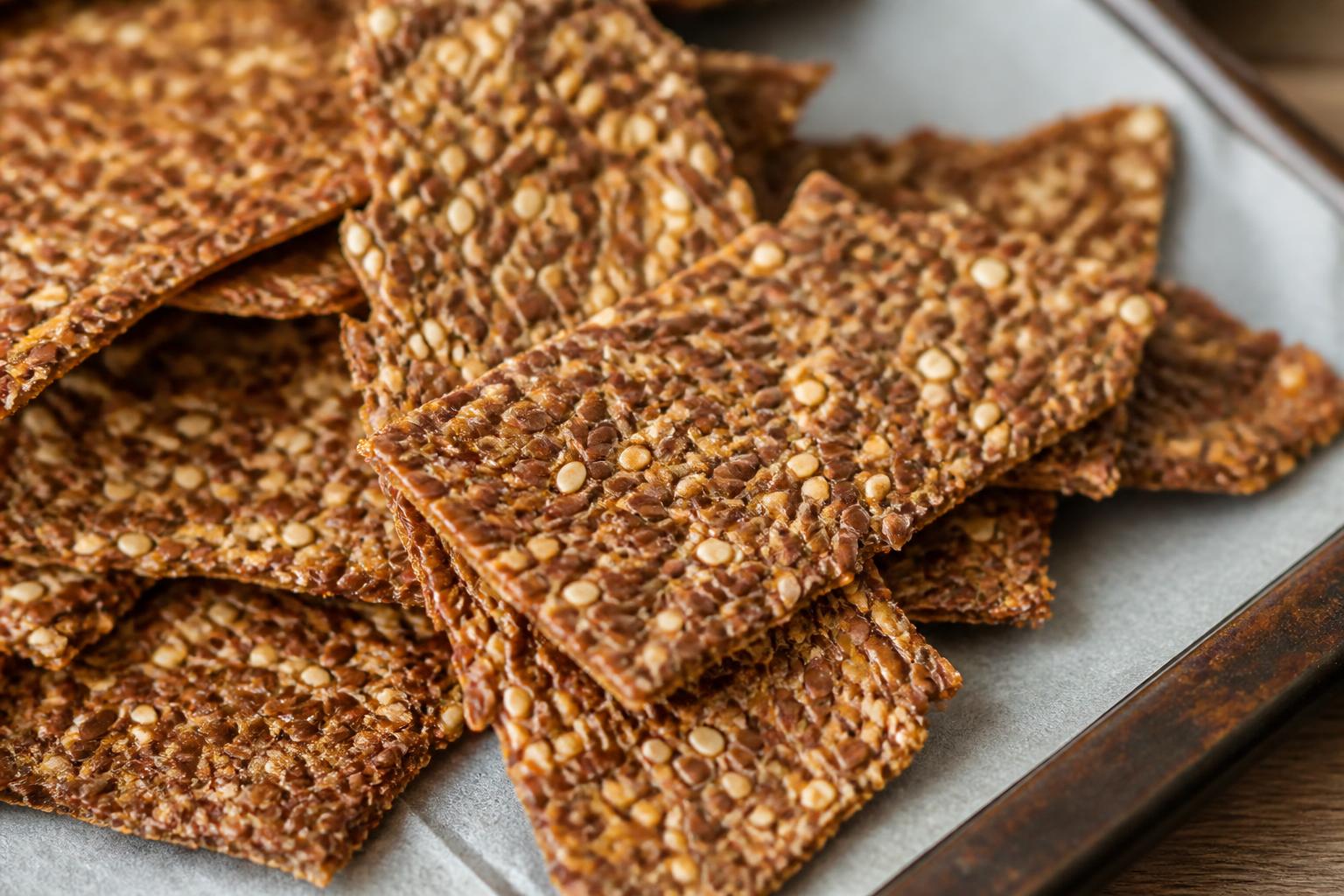
Flax seed crackers are thin, crisp savoury biscuits made with flax seeds as a main ingredient, not just a scattering on top. They sit somewhere between a cracker and a crispbread, but they are their own thing. When they are made well, they snap cleanly, carry toppings without going limp too quickly, and bring a toasty, nutty flavour that feels more substantial than a plain water biscuit.
For everyday snacking, they can be genuinely handy. They are often rich in fibre, usually easy to pair with cheese, hummus, cottage cheese or sliced tomato, and they can work as a crunchy side with soup or salad. But they are not automatically the best choice in every packet, every portion or every situation. The details on the label matter, and so does what you are actually hungry for.
What flax seed crackers actually are
Flax seed crackers are crackers in which flax seeds do some real work. They are not simply standard wheat crackers with a few seeds sprinkled over the top for looks. In many recipes, ground flaxseed, whole flaxseed, or a mix of both helps form the body of the cracker. That changes the flavour, the texture and often the nutrition profile as well.
Flax seeds, also called linseeds in the UK, are small, glossy seeds with a mild nutty taste. In crackers, they can appear whole for visible texture, ground into meal for a more even structure, or both. Ground flaxseed can help hold moisture and support the dough or batter, while whole seeds contribute bite and that pleasing speckled look people expect from seeded products.
It is worth separating flax seed crackers from a few similar shelf staples.
Seeded crispbreads are often larger, airier and more bread-like. Many are based on rye, wheat or oats, with seeds mixed in or pressed on top. They can be very crisp, but they usually feel drier and more rigid than a flax-based cracker.
Oatcakes are denser and more crumbly. Oats give them a hearty, almost biscuit-like quality. Some oatcakes contain seeds, including flax, but oats remain the main character.
Standard crackers are usually built around flour, fat and a raising method, with a lighter, plainer crunch. Even when they are labelled “seeded”, the seeds may be a feature rather than the foundation.
That distinction matters because flax seed crackers behave differently. They often have a deeper toasted flavour, a slightly more delicate break, and a texture that can range from brittle and shattery to firm and rustic. Some are almost translucent and lace-like. Others are thicker and more substantial, especially when they contain pumpkin seeds, sunflower seeds or chia alongside flax.
This is also why two products with similar front-of-pack wording can feel completely different once opened. A “flax cracker” made mostly from tapioca starch or rice flour with a token amount of flax will not eat like one made from flaxseed meal and seeds. If you want the proper thing, the ingredient list tells the truth more reliably than the marketing on the front.
If you want a broader way to sort out similar products, our guide on how to compare seed crackers without guesswork breaks down the differences in a practical way.
How they get their crunch
The crunch in flax seed crackers is not magic. It comes from a few very ordinary food science tricks, and understanding them helps explain why some crackers are satisfyingly crisp while others seem oddly leathery or greasy.
The first factor is water, or more accurately, getting enough of it out. Whether crackers are baked or dehydrated, the goal is to reduce moisture so the finished product snaps rather than bends. Thin spreading helps. So does enough time in the oven or dehydrator.
Baking is the more familiar route. A baked flax cracker may be mixed as a dough or as a loose batter that is spread thinly over a tray and scored before or after baking. Heat drives off moisture, toasts the seeds and deepens the flavour. If the tray is crowded, the layer is too thick, or the baking time is cut short, the centre can stay chewy while the edges over-colour.
Dehydration is common in recipes aimed at people looking for a raw-style product. This method uses lower temperatures over a longer time. It can preserve a lighter seed flavour, but the texture is different. Dehydrated crackers may be crisp, though often in a slightly drier, less browned way than baked ones.
Binders are another big part of the picture. Flaxseed is unusually useful here because once ground and mixed with water, it forms a gel. That helps ingredients cling together. In some recipes, that gel is enough on its own. In others, manufacturers use psyllium husk, chia, starches or flour to improve structure. Each binder changes the final bite.
Psyllium can create a firmer, more elastic cracker. Starches can make the texture lighter or more uniform. Flour can move the product closer to a classic cracker. If the recipe contains a lot of whole seeds without enough binder, the cracker may crumble too easily. If there is too much binder or moisture, it can feel dense.
Oil matters too. A little oil can improve mouthfeel, help with browning and make the crunch seem cleaner rather than dusty. Olive oil, rapeseed oil and sunflower oil are all common. More oil does not always mean a better cracker, though. Too much can weigh it down or leave a slightly slick finish on the fingers.
Seasoning is where texture and taste meet. Salt sharpens flavour and can make a cracker seem crisper simply because the taste is more vivid. Herbs, black pepper, garlic, onion powder and smoked paprika are all common additions. Sesame, rosemary and sea salt is a classic combination. But seasoning also affects how happily the cracker pairs with other foods. A strongly flavoured cracker can overwhelm mild toppings.
Thickness is perhaps the simplest variable of all. A very thin flax cracker can be all snap and no cushion, lovely with soft cheese but less useful for chunky dips. A thicker one may hold avocado or mackerel pâté more confidently, though it can drift towards hard rather than crisp if the balance is off.
That is why a good packet tells a story before you even taste it. A short ingredient list with flaxseed, water, seasoning and perhaps a little oil suggests one style. A list led by starches and flours suggests another. Neither is automatically bad, but they are not the same snack.
What to look for on the label
In the UK, the easiest way to read a cracker label is to start with the ingredients list, then move to the nutrition table, then check the portion guidance and allergen information. Front-of-pack claims are the least useful part if you are trying to understand what you are actually buying.
Ingredients are listed in descending order by weight at the point of manufacture. So if flaxseed appears first, or very near the top, that is a good sign if you want a genuinely flax-forward cracker. If wheat flour, rice flour, tapioca starch or corn flour comes first and flax is further down, the product may still be tasty, but it is not mainly built from flax.
Watch for how the flax is described. “Flaxseed”, “golden linseed”, “brown linseed” and “ground flaxseed” all tell you something. Whole seeds bring more visible texture. Ground flaxseed often means a more integrated cracker. A mix can be ideal.
On the nutrition panel, fibre is one of the first things many people check, and reasonably so. Flax-based products often contain more fibre than plain crackers. In the UK, a food can be labelled “source of fibre” if it contains at least 3g of fibre per 100g, and “high fibre” if it contains at least 6g per 100g. Those are useful thresholds, but they do not tell you the whole story. A cracker can meet the claim on paper and still be easy to overeat if the portion is tiny and the salt is punchy.
Salt is worth a closer look because crisp, savoury snacks often rely on it heavily. UK labels may show salt directly, rather than sodium. That makes comparisons easier. If one packet tastes exciting and another seems plain, the difference is often not just seasoning style but salt level. A modest serving may be fine, but repeated nibbling can add up quickly.
Fat also needs context. Flax seeds naturally contain fat, so a flax cracker may show a higher fat figure than a plain cracker. That is not automatically a red flag. More useful is to look at saturated fat, the ingredient sources of the fat, and how much you are likely to eat in one sitting. A cracker made mostly from seeds will not resemble a low-fat cream cracker on the panel, nor should it.
Portion size can be slippery. Some packets define a serving as two crackers, others as four, others by gram weight. If you are comparing products, compare them per 100g first, then sense-check the serving size against real life. If the serving looks dainty enough to disappear before the kettle boils, it may not reflect how people actually snack.
Allergen information matters even if the product looks simple. In the UK, allergens must be emphasised in the ingredients list, usually in bold. Some flax seed crackers contain wheat or barley. Others may include sesame, milk powders or nuts. Some are made in facilities handling peanuts or tree nuts, which matters for those with allergies depending on the wording and their medical advice. “Gluten free” has a specific meaning in UK law, and if that matters to you, it is better to look for the formal claim than assume a seed cracker is automatically free from gluten.
Be cautious with broad claims such as “natural”, “clean”, “keto-friendly” or “superfood”. These are not all regulated in the same way, and some are more marketing mood than practical guidance. A packet can sound virtuous and still be salty, expensive, or less satisfying than it looks.
If you are building a better snack cupboard overall, our round-up of healthy savoury snacks that keep everyday choices simple is a useful next step.
Where they fit in everyday snacking
Flax seed crackers fit best where you want crunch with a bit more staying power than a plain cracker, but without moving into a full meal. They are especially practical as a base for protein-rich toppings or alongside foods that need a crisp contrast.
A few crackers with hummus and cucumber make sense as a mid-afternoon bridge between lunch and dinner. The same goes for cream cheese and smoked salmon trimmings, cottage cheese and cherry tomatoes, or a slice of cheddar with pickle. They also work well with soup, where one or two can replace bread without feeling like an afterthought.
They can be useful for packed lunches because they travel better than many fresh snacks. A small tub of dip, a few crackers and some carrot sticks is easy to assemble and does not require much preparation. For people who like a desk drawer backup, they are often tidier than crisps and less crumbly than some oatcakes.
That said, they are not always the best answer to hunger. If you are genuinely ravenous, a handful of crackers on their own may not do much beyond making the hunger more noticeable. Pairing them with something containing protein, or using them as part of a broader snack, usually works better.
Convenience matters too. Some flax crackers are fragile and expensive for what they are. If you need a robust, budget-friendly option for children’s lunchboxes, a plain cracker, oatcake or even a slice of toast may be more practical. If you want something very portable and less likely to shatter in a bag, roasted pulses can be easier to live with. Our piece on why roasted chickpeas earn a place in everyday snacking covers that side of the cupboard.
They also suit certain snacking moods better than others. If you want something cool, fresh and savoury, they are excellent under a spoonful of tzatziki or smashed avocado with lemon. If you want comfort and heft on a cold afternoon, they may feel a bit too austere unless paired generously. And if what you are really craving is something sweet, trying to force a savoury cracker into the role rarely ends well.
Budget is a fair consideration. Seed-heavy crackers can be pricier than standard crackers, especially in smaller packs. That does not make them poor value if you enjoy them and use them well, but it does mean they are best treated as one option among many rather than the only “good” snack in the house.
Common myths and sensible limits
Flax seed crackers attract a lot of nutritional glow. Some of that is understandable. Flax seeds are associated with fibre and healthy fats, and crackers made from them can be a more interesting option than ultra-plain savoury biscuits. But the leap from “useful ingredient” to “miracle snack” is where things become muddled.
One common myth is that because flax is widely talked about in health circles, every flax cracker is automatically a healthy choice. It is not that simple. Recipes vary. Portions vary. Toppings vary. A heavily salted cracker eaten by the handful while standing in the kitchen is still a snack food, even if the ingredients sound worthy.
Another myth is that one ingredient can tell you everything. People often assume that if flax is present, the product must be low in carbohydrate, high in protein, ideal for weight loss, or somehow better for everyone. In practice, one packet may be mostly seeds, another may lean on starches, and another may include enough oil and seasoning to change the picture quite a bit. The full label matters more than the hero ingredient.
There is also a tendency to overstate broad nutrition claims around flax itself. You will see confident language online about hormones, heart health, digestion and all manner of wellness promises. Some areas are still debated, some depend on the amount eaten, some depend on the rest of the diet, and some are simply presented too boldly for the evidence behind them. It is wiser to think of flax crackers as one food with a particular texture and ingredient profile, not as a cure-all in cracker form.
Sensible limits matter for practical reasons too. Very fibre-rich foods can be useful, but suddenly eating large amounts when you are not used to them may be uncomfortable. Salt can creep up if you graze across several savoury snacks in a day. And because seed crackers can feel virtuous, it is easy to ignore how much you are actually eating.
Medical advice also matters. People with specific digestive conditions, swallowing difficulties, allergies, or medically prescribed diets should follow the guidance they have been given rather than general snacking advice. Product differences matter here as well. One flax cracker may be suitable for your needs, another may not.
The most useful view is the least dramatic one. Flax seed crackers can be a crisp, nutty, practical option for everyday snacking. They are at their best when we treat them as part of a real eating pattern, read the label properly, and pair them with foods that make the snack satisfying rather than simply crunchy. That keeps them in their sweet spot, not on a pedestal.

Questions about this article or a correction to suggest? Get in touch. Read more about our editorial approach.