Comparing seed crackers properly is less about finding the packet with the most virtuous-looking front and more about knowing which details actually matter. In UK shops, crunchy savoury biscuits and crisp slices often sit side by side even when they behave very differently at lunch, with toppings or as a quick desk snack. Seeds can be a useful ingredient, but they are not a shortcut to “better”.
A sensible seed crackers comparison starts with format, then moves to the back of pack. Check what the product actually is, read the ingredients list, compare fibre and salt using the traffic-light panel where available, and make sure the portion information reflects how you really eat it. After that, texture matters. A cracker that survives a lunch box is doing a different job from one that shatters beautifully under soft cheese.
What counts as a seed cracker, and how it differs from oatcakes, crispbreads and wholegrain crackers
UK supermarket aisles tend to group several crunchy formats together, but they are not interchangeable.
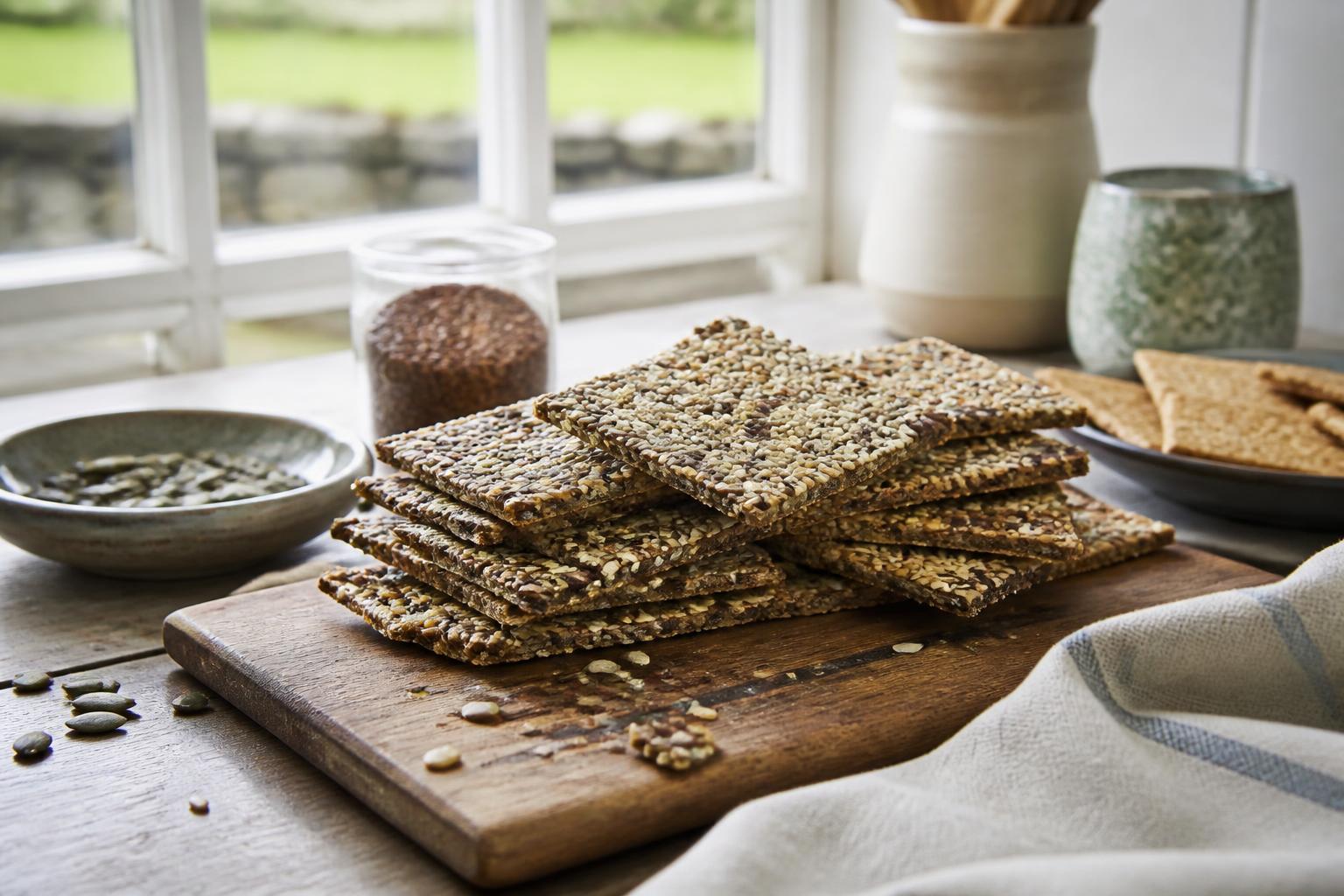
A seed cracker is usually a thin savoury cracker where seeds are a visible and deliberate part of the recipe. That might mean sunflower, pumpkin, sesame, flax or chia seeds, either mixed into a flour-based dough or forming a large share of the structure. Some are wheat-based, some are made with rye or oats, and some are more obviously “seed-heavy” and closer to a pressed seed crisp.
That is different from an oatcake. Traditional oatcakes are generally thicker, denser and more biscuit-like. Oats are the defining ingredient, even if the product also contains wholemeal flour or some seeds. A seeded oatcake is still usually best understood as an oatcake, because the texture and use are shaped more by oats than by the scattered seeds.
Crispbreads are another category again. They are typically lighter, drier and more aerated or compressed, often made with rye, wheat or mixed grains. Some are wafer-thin and brittle, others are slightly more robust. Seeds may appear on top or in the mix, but crispbread is usually identified by its dry, snappy sheet-like structure rather than by any one ingredient.
Wholegrain crackers cover a broader middle ground. These are often baked savoury crackers made with wholemeal flour or a mix of grains, sometimes with seeds, sometimes without. They may feel more familiar if you think of something made for cheese boards, soups or lunchbox nibbling rather than a specialist health-food shelf item.
So where do seeds fit? They are one ingredient family, not a quality stamp. Seeds can contribute texture, nuttiness and sometimes fibre. They can also bring fat, which is not automatically a problem, but it does mean “more seeds” does not always equal “lighter” or “better”. A packet covered in seeds may be exactly what you want for flavour and crunch, but it still needs the same label reading as anything else.
This matters because front-of-pack language can blur categories. “Multiseed”, “wholegrain”, “oven baked” and “source of fibre” tell you something, but not enough on their own. A seed-heavy cracker can still be salty. A wholegrain cracker can still be low in fibre compared with another option on the same shelf. An oatcake can be more filling than a thinner seed cracker, even if the front looks plainer.
How to read the packet without being dazzled by the front
The front of the packet is designed to catch your eye. The back is where the useful comparison happens.
For UK shoppers, current NHS food-label guidance is the practical starting point. On many products you will see front-of-pack traffic lights for fat, saturates, sugars and salt, usually per 100g and sometimes per portion too. For savoury crackers, the most useful parts are often salt, fibre and portion context, plus the ingredients list.
Start with the name of the food. Is it a seed cracker, an oatcake, a crispbread or a wholegrain cracker? That helps you compare like with like. If you compare a delicate rye crispbread with a thick oatcake only by calories per portion, you may miss that they are built for completely different jobs.
Then read the ingredients list. Ingredients are listed in descending order by weight at the point of manufacture. If seeds are the star of the packet but appear well after flour, you know they are present but not dominant. If wholegrain flour or oats appear first, that tells you more about the product’s base. If oils, sugars or syrups appear higher than expected, note that too. Small amounts are common in baked crackers, but the list helps you see what is doing the heavy lifting.
Next, check fibre. The NHS guidance for labels helps with traffic-light style reading, while the fibre declaration on the nutrition panel gives the more direct comparison. A product marketed as wholesome or grain-rich is worth checking here rather than assuming. If one cracker has noticeably more fibre per 100g than another similar one, that may make it a more satisfying choice for some people.
Salt is often the big separator in savoury crunchy snacks. Traffic-light labels make this easier where they are present. Even when the front gives a reassuring picture of grains and seeds, the salt level can still be the deciding factor. For a quick shop-floor comparison, use the per 100g figure rather than portion first, because portion sizes vary between brands and formats.
Then look at portion information with a sceptical but fair eye. UK packs may give nutrition per 100g and per serving. Per serving can be useful if the serving reflects real life. It is less useful if the serving is one tiny cracker and you routinely eat four. We prefer to compare per 100g first, then ask whether the stated serving bears any resemblance to how we would actually use the product.
This is where BDA healthy-snack guidance is helpful in spirit. The practical point is balance and context, not halo language. A cracker is part of a snack or meal, not a magic object. What goes on top, how many you eat, and whether they are replacing something else all matter. If you are pairing them with cheese, hummus or peanut butter, the sturdiness and portion size become just as relevant as the nutrition panel.
One more UK-specific note. Food labels in Great Britain and Northern Ireland can differ in small presentation details from EU packs, especially on products sold across multiple markets, but the core nutrition table and ingredients list remain the essentials for shoppers. If a pack uses both per 100g and per portion, and the portion looks optimistic, trust the per 100g line for comparison.
Texture, sturdiness and crumb factor in real-life snacking
Numbers matter, but so does behaviour.
Oatcakes are usually the workhorses. They tend to be sturdy, less likely to snap in transit, and good under denser toppings such as cheddar, cottage cheese or peanut butter. Their crumb is often a little sandy or oaty rather than explosively flaky, which can make them easier to eat at a desk or in the car, although they are not crumb-free by any means.
Crispbreads vary more than people expect. Thin rye-style crispbreads can be wonderfully crisp but prone to cracking under pressure, especially if you spread something cold and firm straight from the fridge. More robust crispbreads hold up better, but many are still best for plated snacking rather than being rattled around in a bag all morning. They can, however, feel lighter and less dense if that is what you want.
Wholegrain crackers often sit in the middle. They are usually neater than oatcakes and less austere than very dry crispbreads. For lunch boxes, they can be a practical compromise, especially if you want something that works with soft cheese, sliced cucumber or a quick soup-and-cracker lunch. On a cheese board they often look and behave more conventionally, which is useful if you are serving a mixed group.
Seed-heavy crackers are the wild cards. Some are surprisingly robust because the seed matrix is tightly baked. Others are brittle and shattery, especially very thin ones. They can feel luxurious with dips or soft toppings because of the extra crunch and nuttiness, but they may also leave more fragments on a keyboard, car seat or dark jumper. If you are packing snacks for later, this is not trivial.
Crumb factor matters more than marketing admits. For desk snacks, a clean break and controlled bite are genuinely useful. For dipping, you want enough structure to survive a scoop without folding or snapping into the hummus. For lunch boxes, resistance to humidity matters too. A cracker that starts crisp can soften if packed beside cut tomatoes or a leaky dip pot.
If you want practical ideas around portable crunch, our guide to crunchy work snacks that cope without a fridge is a good companion read.
A simple side-by-side method for comparing two packets in the shop
Here is the quick routine we use for a sensible comparison when standing in front of the shelf.
First, compare similar formats if you can. Seed cracker against seed cracker, oatcake against oatcake. If you are comparing across formats, keep in mind that texture and use may matter more than tiny nutrition differences.
Second, read the product name and the first three ingredients. That usually tells you whether the packet is built mainly from oats, wholegrain flour, rye or seeds.
Third, check the nutrition panel per 100g. Focus on fibre and salt first for this category. Then glance at fat and saturates if you want a fuller picture, especially with seed-heavy options where fat may naturally be higher because seeds contain oils.
Fourth, look at the serving size. Ask yourself, “Would I actually eat that amount?” If not, do not let the lower per-portion figure sway you.
Fifth, make a quick practical judgement. Is this for a lunch box, a cheese board, dipping, or emergency desk snacking? The sturdiest or neatest option may be the better buy even if the label numbers are very close.
Here is a clearly fictional worked example.
Packet A is a wholegrain seed cracker. First three ingredients: wholemeal wheat flour, sunflower seeds, rapeseed oil. Per 100g it lists 8g fibre and 1.2g salt. Serving size is 3 crackers.
Packet B is a seeded crispbread. First three ingredients: rye flour, wholegrain rye, sesame seeds. Per 100g it lists 14g fibre and 0.8g salt. Serving size is 2 crispbreads.
If we stopped at the front, Packet A might look more indulgent and “seedier”. On the back, Packet B appears higher in fibre and lower in salt. But that is not the whole answer. If we need something for a lunch box that can handle cream cheese and survive a commute, Packet A might still win on sturdiness. If we want a lighter-feeling base for smoked salmon at home, Packet B might make more sense.
There is also uncertainty where labels vary. Not every pack uses traffic lights. Portion sizes are set by brands, not by your appetite. Some seed crackers are naturally denser, so a smaller number of pieces can weigh more than you think. That is why the best routine is simple: identify the format, compare per 100g, sense-check the serving, then choose for the job.
If you are also watching overall snack size, our piece on 100-calorie snacks that actually keep you going can help with the portion side of the equation.
When each format makes the most sense for everyday use
The best packet is often the one that suits the moment.
For lunch boxes, oatcakes and sturdier wholegrain crackers are usually the easiest choice. They travel well, cope with being stacked, and can stand up to cheddar, egg mayo or hummus without dissolving into crumbs. If you need more ideas for practical packed crunch, see our crunchy lunch box ideas.
For cheese boards, wholegrain crackers and selected seed crackers often shine. Wholegrain crackers tend to be neutral enough not to bully the cheese, while seed-heavy options bring extra crunch and a nuttier feel that can work beautifully with soft cheeses or chutneys. The trade-off is that some seed crackers are so assertive in texture that they become part of the event rather than a backdrop.
For lighter snacks, crispbreads can be useful because they often feel airy and clean rather than dense. That does not automatically make them nutritionally superior, but they can suit the kind of snack where you want crunch with sliced tomato, cottage cheese or a thin spread rather than something more substantial.
For desk drawers and emergency cupboards, sturdiness matters more than romance. Oatcakes and robust wholegrain crackers tend to be less fragile and less messy than delicate crispbreads or ultra-thin seed crisps. If you are building a realistic stash for real working days, our guide to healthy snack ideas for adults that actually fit real days is worth a look.
For dipping, choose structure. Not all crispbreads are built for this, and not all seed crackers survive a generous scoop. A thicker wholegrain cracker or compact seed cracker usually performs better than a wafer-thin crispbread.
For people who want something more filling, oatcakes often earn their place. Their denser texture and oat base can make a small number feel substantial. For people who want maximum crunch with a more dramatic bite, seed-heavy crackers often deliver that best.
The key point in any seed crackers comparison is that seeds are not the finish line. They can add crunch, interest and sometimes fibre, but they do not replace reading the ingredients list or checking salt. A plain-looking oatcake may be the better lunch-box choice. A crispbread may suit a lighter snack better. A wholegrain cracker may be the handiest all-rounder.
So if you want to compare without guesswork, ignore the halo, flip the packet over, and decide what job the cracker needs to do. That is usually enough to make the shelf feel much less noisy.

Questions about this article or a correction to suggest? Get in touch. Read more about our editorial approach.