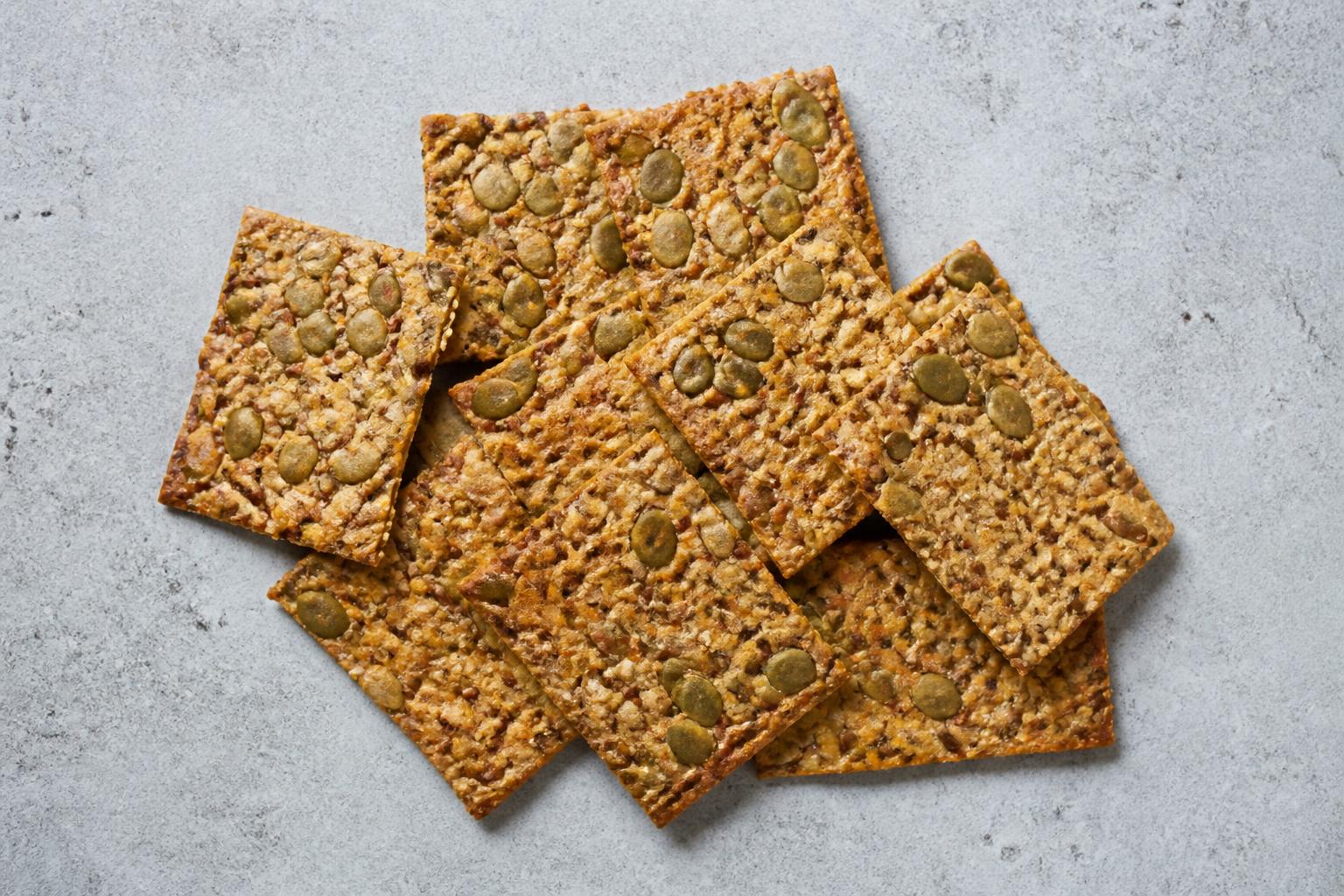
Pumpkin seed crackers are exactly what they sound like, crackers built around pumpkin seeds rather than treating them as a decorative extra on top. In practice, that usually means a darker, nuttier, more substantial cracker with a firmer bite than the average water biscuit or cream cracker. Some are fully seed based, some combine seeds with oats or flours, and some sit somewhere between a cracker and a very thin crispbread.
That matters because they behave differently in the cupboard and on the plate. A good pumpkin seed cracker can be brilliant for quick lunches, desk snacks and cheese boards, but only if you know what kind you are buying, how salty it is, and how to keep it from turning chewy three days after opening.
What pumpkin seed crackers actually are
Pumpkin seed crackers are savoury crackers in which pumpkin seeds play a central structural role, not just a garnish. You will usually see them sold in one of three broad formats.
The first is the classic seed cracker, made from a mixture of pumpkin seeds, sunflower seeds, flax or linseeds, sesame seeds, chia, and a binder such as egg white, psyllium husk, starch or a small amount of flour. These are often thin, rigid and quite rustic looking, with visible whole seeds throughout.
The second is a grain and seed cracker, where pumpkin seeds are mixed into a base of wheat flour, rye flour, oat flour or oats. These tend to look more like familiar crackers from the biscuit aisle, but with a rougher surface and more texture.
The third is the very crisp, sheet style cracker that borders on crispbread. These can be snappy and dry, often broken into irregular pieces, and may be sold as flatbreads, thins or seeded crisps depending on the brand.
It helps to separate pumpkin seed crackers from a few neighbouring categories.
Seeded wheat crackers are usually still wheat crackers first. They may have pumpkin seeds on top or scattered through the dough, but flour remains the main ingredient and the cracker eats like a standard savoury biscuit with added crunch.
Crispbreads are generally drier, airier or more rigid, often designed as a bread replacement. Some pumpkin seed crispbreads exist, but they are not always what shoppers mean when they want a cracker for dips or cheese.
Savoury biscuits are often richer and more biscuit like, sometimes containing more fat, sugar or raising agents for a crumbly texture. A pumpkin seed savoury biscuit may taste lovely, but it is not necessarily the same thing as a seed-led cracker.
The ingredient list usually tells the story quickly. If pumpkin seeds appear right at the top, alongside other seeds, you are probably looking at a proper seed cracker. If they appear much further down after wheat flour, palm oil or starches, you are more likely buying a conventional cracker with pumpkin seeds added for flavour and appearance.
That distinction is worth making because people often expect one format and buy another. If you want the dense, seeded snap that works well with hummus or soft cheese, a lightly topped wheat cracker may feel underwhelming. If you want something delicate for smoked salmon or pâté, a heavy seed slab may feel like too much.
If you enjoy comparing one seed format with another, our guide on how to compare seed crackers without guesswork makes the differences easier to spot before you get to the checkout.
Why they feel different from ordinary crackers
Pumpkin seeds change more than the flavour. They alter the whole eating experience.
First, the crunch is different. Ordinary crackers often break with a light, dry snap because the structure comes mainly from baked flour and starch. Pumpkin seed crackers tend to crack more firmly and more noisily, especially when whole seeds are packed closely together. You get a layered kind of crunch, not just one clean snap. The seeds themselves resist the bite before giving way, so the texture feels more substantial.
Second, they are usually denser. Even when thin, seed-heavy crackers can feel weightier in the hand and in the mouth. A few pieces may feel more satisfying than the same number of plain crackers, simply because there is more going on structurally. That does not automatically make them better, but it does make them different. They are often less of a mindless nibble and more of a deliberate snack.
Flavour is another obvious shift. Pumpkin seeds bring a rounded, nutty, faintly earthy taste, sometimes with a gentle roasted note if the seeds have browned well during baking. They are not as assertive as some seeds, but they do add depth. That means toppings matter. Mild cream cheese, cottage cheese, avocado, houmous and sliced cucumber often work well because they let the cracker keep some personality. Very salty toppings can tip the whole thing into overload.
Colour changes too. Pumpkin seed crackers are often deeper brown, olive green or speckled gold and dark green, rather than pale beige. That comes from the seeds themselves and from the oils they contain, which toast during baking. If flax, chia or rye are also involved, the look gets darker still.
Then there is the question of how filling they feel. We are careful here because a label cannot tell you exactly how full you will feel after eating them. But in everyday terms, many people find seed crackers more substantial than ordinary crackers because of their density, fat content from the seeds, and often higher fibre content. You notice them more. They ask to be chewed. They rarely vanish in the same absent-minded way as a sleeve of thin wheat crackers.
That can be useful, especially if you want a snack that feels like a real pause rather than a handful of air. It can also catch people out. If you serve them exactly as you would a very light cracker, the portion can become larger than intended simply because each one carries more substance.
If you like exploring how different seeds change the same basic format, our pieces on chia seed crackers for everyday snacking and poppy seed crackers for everyday snacking show how much texture and flavour can shift with one ingredient swap.
What to check on the label before you buy
The front of the pack will usually sell you a mood. The back of the pack tells you what you are actually taking home.
Start with the ingredients list. In the UK, ingredients are listed in descending order by weight at the point of manufacture. So if pumpkin seeds are first or second, they are genuinely central. If they appear after wheat flour, refined starches or oils, they may be present in much smaller amounts than the front suggests.
Check whether the crackers are mostly seeds, mostly flour, or a blend. None of those is automatically right or wrong, but they suit different jobs. A mostly seed cracker is often stronger flavoured, more brittle once opened, and more filling. A flour-led cracker may be lighter and easier for topping.
Look at the allergen information carefully. Under UK food labelling rules, major allergens must be emphasised in the ingredients list, often in bold. With pumpkin seed crackers, the obvious watch points are sesame, wheat and other gluten containing cereals. Some recipes also include nuts, so a seed cracker is not automatically nut free. If the pack says "may contain" for nuts, milk or other allergens, that matters for anyone managing a food allergy in the household.
Salt is worth checking because savoury crackers can vary more than people expect. Seed based products often have enough flavour to work with less salt, but some brands still lean hard on seasoning. Comparing salt per 100g is the easiest way to judge one product against another. Comparing only "per cracker" can be misleading when cracker sizes differ wildly.
The same goes for fibre. A seed heavy cracker may contain more fibre than a plain cracker, but the useful comparison is usually per 100g first, then per serving if the serving size seems realistic. Be a little sceptical of tiny suggested portions. If the pack suggests a serving of three miniature crackers and you know you will eat nine with lunch, read the numbers with that in mind.
Portion information matters most when the crackers are dense. A small handful can weigh more than it looks. If you are trying to understand how a cracker fits into your normal routine, the serving size on the packet is only a starting point, not a command.
Also check the oils and sweeteners. Some pumpkin seed crackers are very straightforward, built from seeds, water, seasoning and a binder. Others include glucose syrup, malt extract or added sugars for colour and flavour balance. Again, this is not automatically a problem, but it changes the style of the cracker.
If the pack uses terms such as "high in fibre" or other nutrition claims, those are regulated in the UK. Since Brexit, Great Britain uses retained UK rules rather than EU law directly, though the practical wording on packs often looks very similar to what shoppers know from EU products. Northern Ireland follows a different regulatory position in some areas because of the Windsor Framework arrangements, so imported products can occasionally look slightly different. For most shoppers, the practical point is simple, read the actual nutrition panel and ingredients list rather than relying only on front of pack language.
How pumpkin seed crackers fit into everyday snacking
This is where pumpkin seed crackers earn their keep. They are practical.
They make sense when you want a snack that can bridge the gap between meals without turning into a full lunch by accident. A few crackers with hummus at 4 pm, a couple with cream cheese and tomato after a late meeting, or a small plate with apple slices and cheddar on a weekend afternoon all feel natural in a UK routine.
They are also useful in the lunchbox sense, even for adults. If your lunch tends to be soup, salad or leftovers that need something crisp on the side, pumpkin seed crackers can do the job without needing refrigeration. They travel better than toast and feel more deliberate than grabbing whatever is in the biscuit tin.
Pairings matter because these crackers already bring plenty of texture and flavour. Soft toppings usually work best. Think hummus, whipped feta, cream cheese, ricotta, egg mayo, smashed avocado or mackerel pâté. For simple grazing, pair them with cucumber, radishes, cherry tomatoes or grapes. Hard, dry toppings on a very dense cracker can become a bit of a jaw workout.
Cheese boards are another obvious home. Pumpkin seed crackers are especially good with soft goat's cheese, Brie style cheeses and blue cheese, because the creamy richness balances the toasted seed character. With very mature cheddar, choose a simpler cracker or keep the portion small so the two do not compete.
They can also stand in for croutons. Crumble a few over soup just before serving, or add broken pieces to a salad for crunch. The trick is to add them at the last minute because seed crackers soften quickly once they meet dressing or steam.
For realistic portions, think in terms of purpose rather than abstract restraint. Are the crackers the snack, or are they the vehicle for something else? If they are there mainly to carry a topping, two to four may be enough. If they are part of a small plate with fruit, cheese and vegetables, the portion can stay modest because the rest of the plate is doing some of the work.
What tends to go wrong is eating straight from the pack while standing in the kitchen. Dense crackers disappear more slowly than light ones, but not slowly enough to save you from autopilot. Put them on a plate, add whatever you are pairing them with, and the portion becomes much easier to judge.
How to keep them crisp at home
Seed crackers are unforgiving about moisture. Once they lose their snap, they rarely become appealingly soft. They just drift into a stale, bendy middle ground.
The first rule is to reseal the pack properly straight after opening. If the original packaging has a good adhesive strip or zip, press it closed firmly and squeeze out excess air. If it does not, move the crackers to an airtight container as soon as you open them. A rigid container usually protects texture better than a loosely clipped bag, especially if the crackers are thin and fragile.
Store them somewhere cool and dry, but not in the fridge. Refrigerators are humid environments, and that humidity is exactly what crisp crackers do not want. A kitchen cupboard away from the kettle, oven and dishwasher is usually a better choice than a shelf above the hob, where steam and heat fluctuate all the time.
Be careful with serving bowls. If you tip out more than you need and leave the bowl on the table through a long lunch, the crackers start pulling in moisture from the air, especially on damp days. Seed heavy crackers can change texture surprisingly quickly because the structure is less uniform than a standard flour cracker. Tiny gaps between seeds and a higher oil content can make the loss of crispness more noticeable.
The same applies to topping them too early. If you are using soft cheese, hummus or anything wet, top them just before eating. A pumpkin seed cracker can go from beautifully crisp to slightly leathery in minutes if it is left sitting under something moist.
If a pack has already softened, all is not always lost. Some crackers can be refreshed briefly in a low oven, then cooled completely before storing again. This works best when they have merely picked up a little ambient moisture, not when they are fully stale or have been sitting with wet toppings. Watch them closely, because seed rich crackers can catch and overbrown faster than plain ones.
Texture changes faster in some pumpkin seed crackers because there is simply more exposed seed surface. Whole seeds contain natural oils, and while those oils help flavour and crunch when the crackers are fresh, they also make the product feel less forgiving once the balance shifts. A plain flour cracker may go a bit dull before it goes truly unpleasant. A seed cracker often announces the problem sooner.
If you are making your own, our guide on how to make seed crackers that stay crisp covers the practical side, from drying them properly to cooling them before storage.
Pumpkin seed crackers are at their best when you treat them as their own thing, not as a novelty version of an ordinary cracker. They are darker, sturdier, more flavourful and often more useful than they first appear. Buy the format that suits how you actually snack, read the label with a clear eye, and store them as though crispness matters, because with seed crackers it really does.

Questions about this article or a correction to suggest? Get in touch. Read more about our editorial approach.