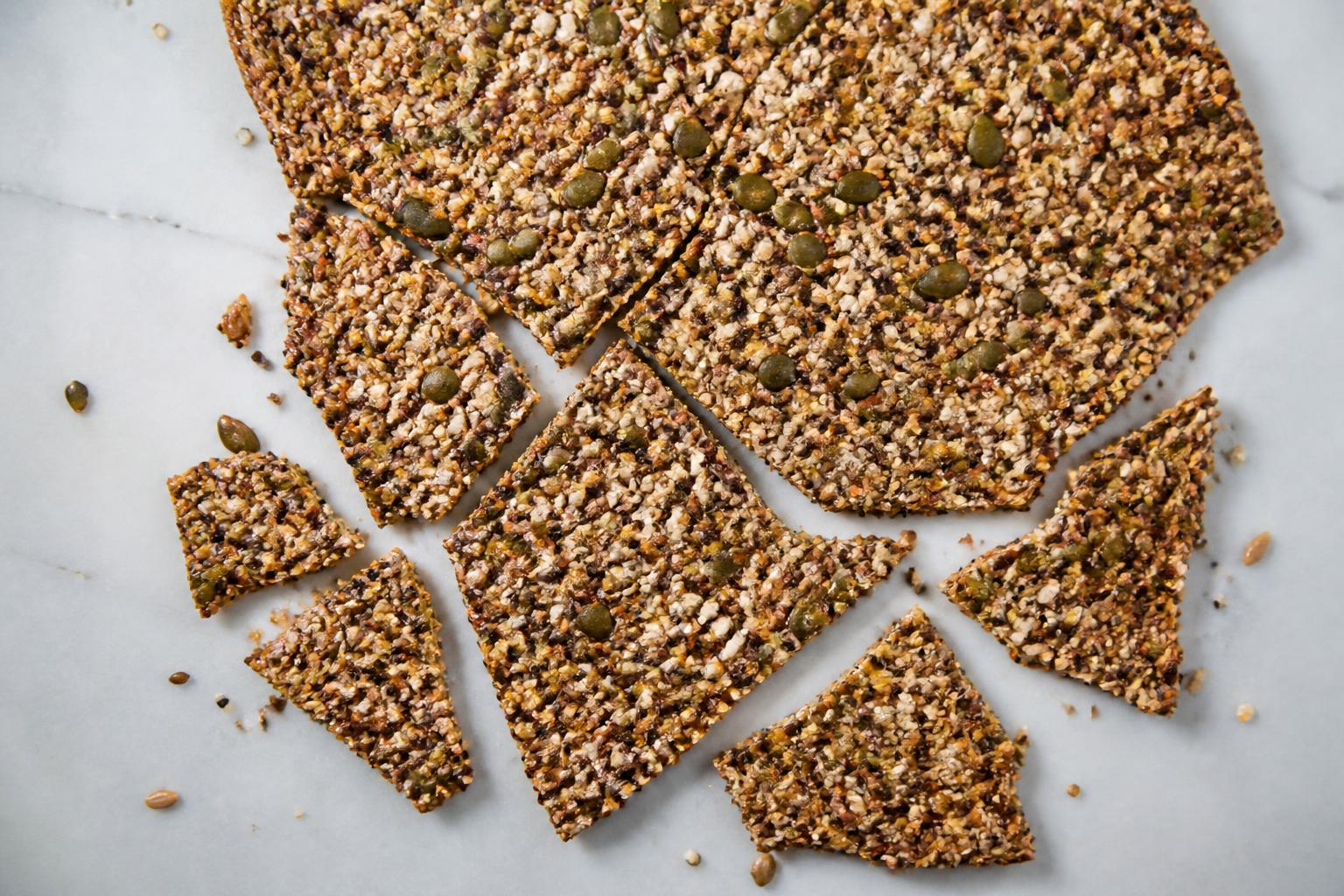
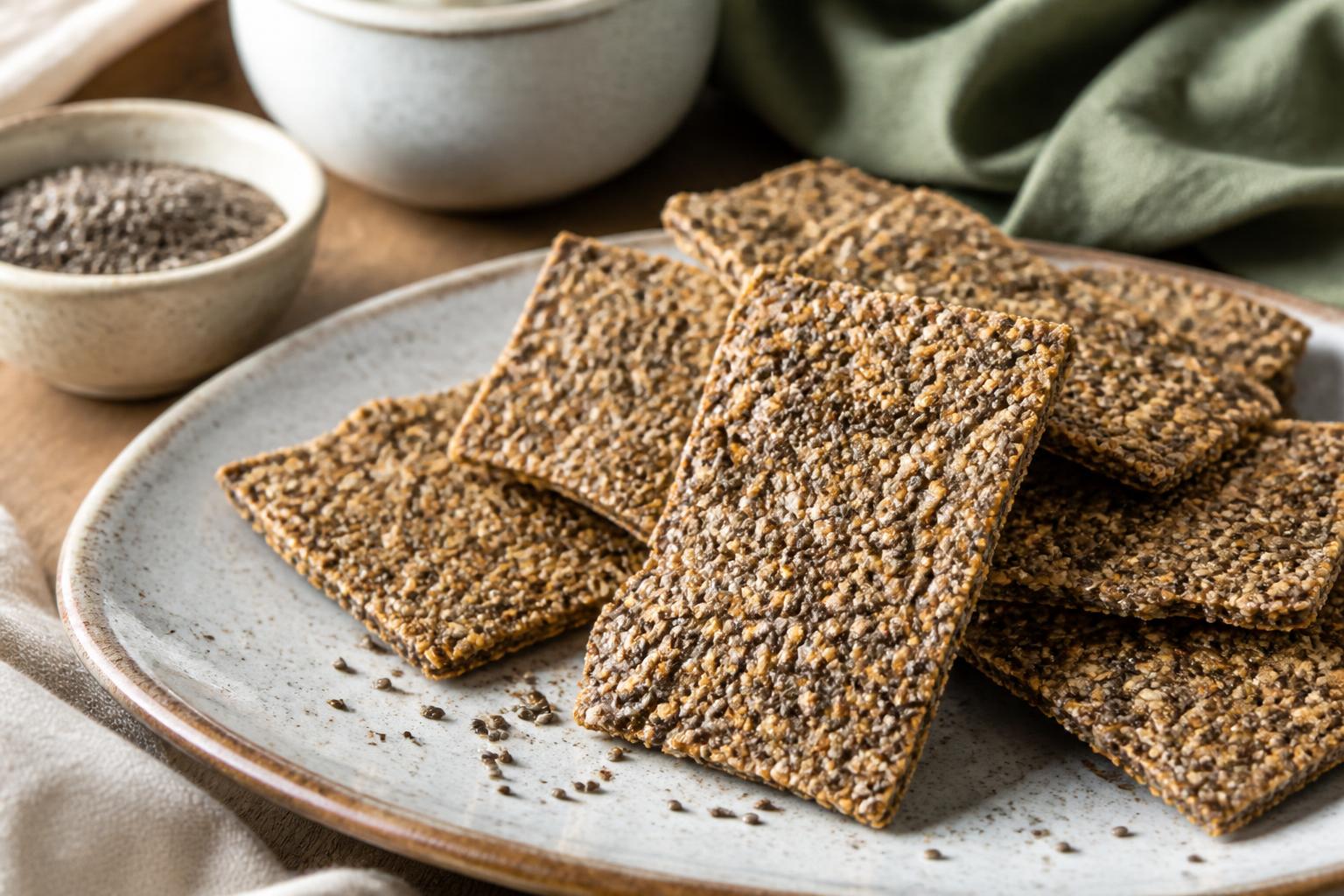
Chia seed crackers are crisp, usually thin crackers made with chia seeds as a key ingredient rather than a decorative sprinkle on top. In practical terms, that means the seeds do some real work. They help hold the dough or seed mixture together, they influence the bite, and they give the finished cracker that speckled, nutty look people often associate with seeded snacks.
For everyday snacking, they sit somewhere between a classic crispbread and a mixed-seed cracker. Some are light and snappy, others are dense and hearty. The difference usually comes down to how much chia is used, what it is paired with, and whether the base is mostly flour, mostly seeds, or a blend of both. If you are trying to work out whether they are worth keeping in the cupboard, the useful question is not whether they are magically healthy. It is what they are made from, how filling they are, and how they fit into the way you actually snack.
What chia seed crackers actually are
Chia seed crackers are crackers in which chia seeds are part of the structure, not just part of the garnish. The seeds may be mixed into a flour-based dough, stirred into a seed-and-water mixture, or combined with ingredients such as oats, linseeds, sesame seeds, sunflower seeds or psyllium to create a sliceable or spreadable batter that bakes into a crisp sheet.
That matters because chia behaves differently from many other seeds. Sesame and poppy seeds mostly add flavour and appearance. Sunflower and pumpkin seeds bring more obvious bite and richness. Chia, by contrast, changes the way the whole cracker comes together.
You will see a few broad styles on shop shelves and in homemade versions:
- Flour crackers with chia mixed through, often closer to a savoury biscuit or thin crispbread
- Seed crackers where chia is one of several seeds, often with a more rugged, dense bite
- Gluten free crackers where chia helps replace some of the binding usually provided by wheat flour
- High-fibre style crackers that lean heavily on whole seeds and minimal starch
Compared with plain crisp crackers, chia seed crackers often look darker, more speckled and more substantial. Compared with many seeded snacks, they are usually flatter and more uniform because the chia helps the mixture set into a sheet rather than staying loose and crumbly.
They also differ from puffed seed snacks or clusters. A cracker is meant to be dry, stable and snappable. A cluster is often chunkier and less even. That sounds obvious, but it helps when you are comparing products that all sit in the same healthy-snack aisle.
Flavour-wise, chia is fairly mild. It has a subtle nuttiness rather than the strong toasted taste of sesame or the earthy note of flax. In many crackers, the dominant taste comes from salt, herbs, rosemary, black pepper, cheese powder, or the other seeds in the mix. Chia’s contribution is often more about texture than headline flavour.
If you enjoy the idea of a crunchy, seed-forward snack but want to compare formats, our guide to seed cracker comparisons without guesswork is a useful next step.
How chia changes the texture and structure
The reason chia turns up so often in crackers is simple. When the seeds are mixed with liquid, they absorb it and form a gel-like coating. You will notice this quickly if you leave chia in water for a few minutes. That hydration effect helps the seeds act as a binder.
In a cracker mixture, that can do several jobs at once.
First, it helps hold dry ingredients together. If you are working with lots of loose seeds, oats or coarse meal, the hydrated chia helps stop everything from falling apart before baking. That is why chia appears so often in recipes that are low in flour or completely flour free.
Second, it affects the final crunch. A cracker made with a hydrated seed mixture can bake into something that is crisp but not airy. Think more clean snap than bubbly puff. The exact result depends on the other ingredients, the thickness of the spread, and how thoroughly moisture is driven off during baking, but chia often nudges the texture towards compact and crisp rather than flaky.
Third, it influences density. Chia seed crackers can feel more substantial than very light wheat crackers because the seeds add bulk and absorb water before baking. That does not automatically make them heavy, but it does mean they often eat more like a deliberate snack than a background nibble.
Appearance changes too. Chia seeds are tiny, oval and dark, so they create that familiar dotted look throughout the cracker. White chia exists, but many retail crackers use black chia or a mix, which gives a stronger visual contrast.
One useful detail for home bakers and label readers alike is that chia can help with structure even when it is not the main ingredient. A cracker may contain only a modest amount, but that amount can still matter if the formula relies on it for cohesion. If you are interested in the practical side of baking and storage, our piece on making seed crackers that stay crisp covers the texture side in more depth.
There is also a difference between whole chia seeds and milled chia. Whole seeds give visible speckles and a more obvious seeded character. Ground chia blends more smoothly and can make the cracker feel less pebbly. On a label, you might see chia seeds listed plainly, or occasionally ground chia, chia flour, or Salvia hispanica, which is the plant name.
The key point is that chia is not there by accident. In crackers, it is often part ingredient, part engineering.
What to look for on the label
If you are buying chia seed crackers in the UK, the back of the pack tells you far more than the front. Words like natural, wholesome, source of fibre, or gluten free may be useful, but they do not replace reading the ingredients list and nutrition panel.
Start with the ingredients list. In the UK, ingredients are listed in descending order by weight at the time of manufacture. If chia appears near the top, it is likely a central ingredient. If it is near the end, the product may be more of a standard cracker with a small chia addition.
Look for what surrounds it. Is the base made from wholegrain flour, refined flour, oats, or mostly seeds? Is the fat olive oil, rapeseed oil, sunflower oil, butter, or palm fat? Are there extras such as sugar, syrup, malt extract, flavourings, or starches? None of these automatically make a cracker good or bad, but they tell you what sort of snack it really is.
Then check the nutrition declaration, which in the UK is usually given per 100g and often per portion as well. The per 100g column is best for comparing products side by side because portion sizes vary wildly.
The most useful lines to compare are:
- Fibre, especially if you are choosing seeded crackers for staying power
- Salt, because savoury crackers can climb quickly
- Fat and saturates, since seed-based crackers often contain more fat than plain crispbreads, even if much of it comes naturally from seeds
- Protein, if you want a snack that feels a bit more substantial
- Energy, particularly if you tend to eat crackers by the handful rather than by the suggested serving
Portion size deserves a pause. A label might define one portion as two crackers, three crackers, or a very specific gram amount. That is fine for standardisation, but it may not match how you eat. If six small crackers disappear while you are making tea, the per-portion figure is not much help unless you do the maths.
Allergen information matters too. In the UK, the 14 major allergens must be clearly emphasised in the ingredients list, often in bold. Chia itself is not one of the 14 mandatory declarable allergens, but chia crackers commonly contain or may contain sesame, gluten, milk, soya, or nuts depending on the recipe and factory. Seed mixes are especially worth checking if you have a sesame allergy, because sesame is a major allergen and turns up frequently in this category.
You may also see precautionary wording such as may contain nuts or made in a factory that handles peanuts. That is not the same as an ingredient listing, but for some people it is still important.
For packs sold in Great Britain, food labelling follows UK rules. In Northern Ireland, some food labelling still aligns more closely with EU arrangements because of the Windsor Framework and the region’s trading position. For everyday shoppers, the practical difference is usually not dramatic on a packet of crackers, but product markings and some regulatory details can differ. The core habits still hold, read the ingredients, compare per 100g, and check allergens carefully.
If you want a broader framework for reading this category, our article on how to compare seed crackers without guesswork breaks the process down in more detail.
Where they fit in a practical snack routine
Chia seed crackers make the most sense when you want crunch with a bit more substance than a very light crisp or rice cake. They are handy in that middle ground where you want something savoury and crisp, but you also want it to pair well with a topping or carry you through to the next meal.
A few practical moments where they fit well:
Mid-morning, when fruit alone feels too fleeting. A couple of crackers with cottage cheese, hummus or peanut butter add crunch and make the snack feel finished.
Mid-afternoon, when the vending-machine mood starts. Seeded crackers with a protein-rich topping can be more satisfying than picking at plain biscuits.
As a desk snack, because they are tidy enough to keep in a drawer if the pack seals well.
Alongside soup or salad, where they can stand in for bread without trying to imitate it.
For lunchbox use, especially if you want something robust that travels better than soft bread.
Pairing matters. On their own, chia crackers can sometimes feel a bit austere, especially if they are very dry and seed-heavy. They come into their own with something creamy, juicy or punchy.
Good pairings include:
- Hummus, beetroot dip or baba ganoush
- Cream cheese or soft goat’s cheese
- Avocado with lemon and black pepper
- Tinned fish, such as mackerel or sardines
- Sliced cucumber, tomato or radish
- Apple slices with nut butter
- A wedge of cheddar and a few grapes
The trick is to think about contrast. Dry crackers want moisture. Mild crackers want a sharper topping. Dense crackers often work best with simple toppings rather than piling on everything in the fridge.
Portions are where good intentions often go crunchy. Because crackers are neat, stackable and easy to nibble, it is easy to treat them as low-stakes food and keep reaching back into the packet. A realistic portion depends on the size and density of the cracker, but it helps to decide whether you are having a small snack, a topping vehicle, or part of a meal. Those are not the same thing.
A practical approach is to put a serving on a plate, add a topping, and stop there rather than eating from the open packet. It sounds almost annoyingly obvious, but it works. Seeded crackers can be surprisingly energy-dense because seeds and oils are naturally rich ingredients.
Storage matters too. Once opened, crackers are at their best when kept dry and well sealed. Seed-rich crackers can lose their snap and taste flat if they pick up moisture from the air. If you make your own, our guide to keeping homemade seed crackers crisp is worth bookmarking.
Common questions about nutrition and safety
The biggest nutrition question around chia seed crackers is usually whether they are automatically healthier than ordinary crackers. The short answer is no, not automatically. They may offer more fibre and a more substantial texture, and seeds can contribute unsaturated fats and minerals, but the overall picture still depends on the full recipe. A cracker made mostly from refined starch with a token sprinkle of chia is a different thing from one built around whole seeds and wholegrains.
Health claims need a bit of caution. In the UK, specific nutrition and health claims are regulated, so a pack cannot just say whatever it likes. You may see authorised claims if the product meets the criteria, such as claims about fibre content. What you should not do is assume that the presence of chia turns a cracker into a nutritional halo object. It is still a cracker, and context still matters.
Hydration comes up often because chia absorbs liquid. In normal food use, chia seeds in crackers are already incorporated into a baked product, so they are not behaving like a spoonful of dry seeds swelling in a glass. For most people, the common-sense approach is enough, eat them as part of normal meals and snacks and drink fluids as you usually would. There is no need for ritualistic extra hydration every time you eat a seeded cracker.
Seed content is another point of confusion. More seeds do not always mean a better choice. A very seed-heavy cracker may be high in fibre and rich in texture, but it may also be more energy-dense and more fragile for some digestions. Whether that suits you depends on what you are after. If you want a topping base, a balanced flour-and-seed cracker may be more practical. If you want something small but filling, a denser seed cracker may suit you better.
Some people do need to take extra care. Anyone with difficulty swallowing should be cautious with dry, hard crackers in general, especially heavily seeded ones, because they can be scratchy and require thorough chewing. People with bowel conditions, recent digestive surgery, or medical advice to limit seeds or high-fibre foods should follow that advice rather than assuming a seeded cracker is automatically suitable.
Allergy risk is the other obvious consideration. Sesame is the standout issue in this category, and mixed-seed crackers may also involve nuts or traces from shared production lines. Always check the pack, even if you have bought a similar product before, because recipes and manufacturing sites can change.
Finally, remember that chia seed crackers are best thought of as one useful format among many. They can be crisp, handy, satisfying and easy to pair with everyday foods. They are not magic, and they do not need to be. If you like a snack with a proper snap, a bit of nuttiness, and enough structure to carry something tasty from plate to mouth without collapsing, they have earned their place in the cupboard.

Questions about this article or a correction to suggest? Get in touch. Read more about our editorial approach.