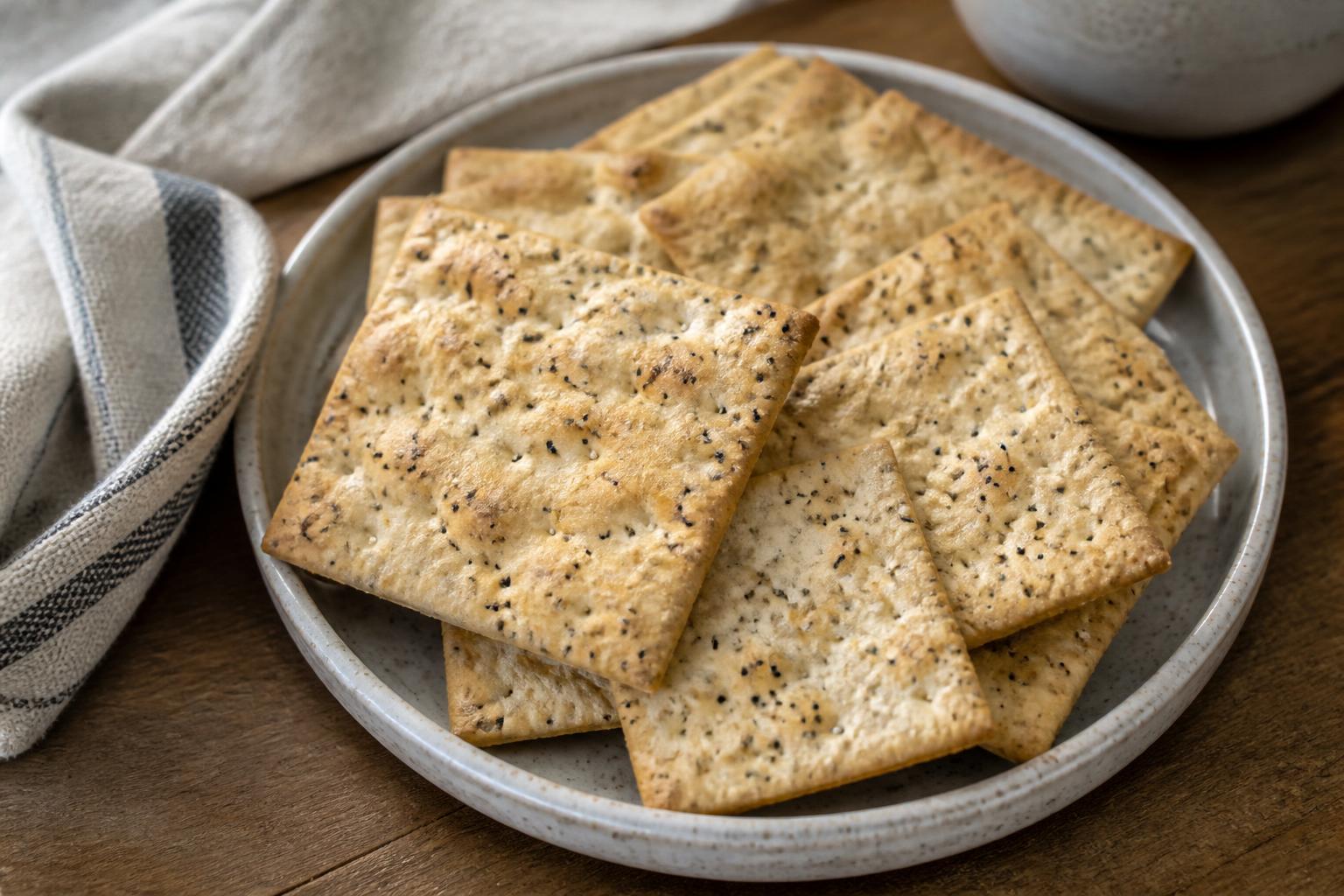
Poppy seed crackers are exactly what they sound like, crackers made with poppy seeds as a visible, textural part of the recipe rather than a tiny decorative extra. In everyday snacking, they sit somewhere between a plain savoury biscuit and a more heavily seeded crisp cracker. The appeal is not only the flavour, which is mild and nutty, but the way the seeds change the bite.
In the UK, you will see them in a few different forms. Some are thin and snappy, some are slightly thicker and more biscuit-like, and some lean into a seeded, almost rustic style. That variety is why it helps to know what you are actually buying, what the label is telling you, and how to judge whether a box suits the kind of snack you want.
What are poppy seed crackers?
Poppy seed crackers are baked savoury crackers that include poppy seeds in the dough or pressed onto the surface, and often both. They are usually dry, crisp, and designed for nibbling on their own or pairing with toppings, dips, or cheese.
In UK shops, the main formats tend to fall into three broad groups.
The first is the classic thin cracker. This is the sort that snaps cleanly, often comes in neat rectangles or rounds, and is built for a light crunch. In this style, the poppy seeds are usually scattered quite evenly through a wheat-based dough. The result is tidy, crisp, and easy to serve with spreads.
The second is a more robust seeded cracker. This one may contain poppy seeds alongside sesame, linseed, sunflower seeds, or pumpkin seeds. It is often darker in colour, thicker at the edge, and more obviously grain-led. It still counts as a cracker, but it can feel closer to a savoury biscuit in density.
The third is the deli-style or artisan-style cracker, which may be irregular in shape, visibly blistered from baking, and seasoned with sea salt, pepper, rosemary, or onion. Here, poppy seeds often contribute as much to appearance as to texture, giving the surface that dotted black-blue look many people associate with bakery products.
It helps to separate these from a few nearby categories.
Crispbreads are usually drier, plainer, and more bread-like in structure. They are often made to be a base for toppings rather than a snack with much richness of their own. Rye crispbreads are the obvious example. They break with a firm crack, but they are not usually as short or biscuit-like as crackers.
Oatcakes are different again. Even when crisp, they tend to be more crumbly and substantial, with the soft graininess that comes from oats. A poppy seed oatcake may exist, but it will not eat like a poppy seed cracker made from wheat flour and oil.
Seeded flatbreads can overlap with crackers, especially in the premium aisle, but many are less brittle and more layered or bubbled. Some are almost crisp pieces of baked dough rather than classic crackers. If the pack talks about hand-stretched dough, olive oil, or a flatbread format, expect something slightly different from a standard cracker.
So when we talk about poppy seed crackers, we mean a broad family of crisp savoury snacks where poppy seeds are a defining part of the texture and look, not just a garnish.
Why do poppy seeds change the texture so much?
Poppy seeds are tiny, but they have an outsized effect on how a cracker feels in the mouth. That starts with their physical structure. They are small, hard, and smooth, so they interrupt the dough in lots of little points rather than in a few large chunks.
In a very thin cracker, that interruption can make the bite feel more delicate. The dough shatters, and the seeds add a faint granular snap without making the cracker heavy. You notice a sort of fine crackle rather than a chunky crunch.
In a thicker or denser cracker, the same seeds can make the texture feel heartier. That is partly because there is more crumb around them, and partly because the seeds are held in a firmer structure. Instead of disappearing into a crisp sheet, they become part of a more substantial chew-crunch combination.
The distribution matters too. A cracker with poppy seeds evenly mixed through the dough tends to feel integrated and balanced. One with a heavy coating on the outside can feel rougher, toastier, and more dramatic on the tongue, even if the ingredient list is similar.
Baking changes things further. Poppy seeds toast quickly, and that can sharpen their contribution. In a pale, lightly baked cracker, they may come across as subtle and almost buttery. In a darker bake, they can feel more pronounced, with a deeper roasted note and a crisper edge to the bite.
Oil level also plays a part. A richer dough can make the seeds seem gentler because the fat rounds out the texture. A leaner dough, especially one made to be very crisp and dry, lets the seeds stand out more clearly.
That is why two packs of poppy seed crackers can look related on the shelf and still eat very differently. The seed is the same, but the thickness, flour choice, fat level, and bake all change the final effect.
What goes into poppy seed crackers?
Most poppy seed crackers begin with a flour, a fat, water, and seasoning. From there, recipes branch off depending on whether the aim is a plain crisp cracker, a multi-seed savoury biscuit, or something closer to an artisan flat cracker.
Flour is usually the backbone. Wheat flour is common because it gives structure and a familiar cracker snap. White wheat flour tends to produce a lighter, cleaner break. Wholemeal wheat flour usually gives a darker colour and a slightly more robust texture. Some recipes combine the two. You may also see rye flour, spelt flour, or oat flour in smaller amounts for flavour and texture.
Oil or fat shapes both crispness and richness. Rapeseed oil is common in UK products because it is fairly neutral and works well in savoury baking. Sunflower oil and olive oil also appear regularly. Butter can be used in richer crackers, though many shelf-stable products rely on vegetable oils instead. The more fat in the dough, the more tender and short the cracker may feel.
Poppy seeds can be a modest inclusion or a major one. In a simple cracker, they may be there mainly for texture and appearance. In a seeded recipe, they are one part of a broader seed mix. Because they are small, they spread easily through the dough and create a more even effect than larger seeds.
Other seeds often appear alongside them. Sesame adds nuttiness and a slightly oily crunch. Linseed, also called flaxseed, can soften the bite a little and bring a different kind of seediness. Sunflower and pumpkin seeds make a cracker feel chunkier and more substantial. If you want to compare how different seeds behave in similar snacks, our guides to chia seed crackers for everyday snacking and flax seed crackers made simple are useful companions.
Raising agents are sometimes included, though not always. Depending on the style, you might see bicarbonate of soda or another leavening ingredient to lighten the texture slightly. Some crackers are unleavened or only minimally raised, which gives a denser snap.
Seasonings can be very simple, just salt, or more involved. Black pepper, garlic powder, onion powder, rosemary, chilli, and sea salt flakes are all common. Sugar may appear in small amounts, not to make the cracker sweet but to balance flavour and help with browning.
You may also find starches, malt extract, yeast extract, or acidity regulators in some products. These are not automatically a sign of a poor cracker. They often help with texture, colour, or shelf life. The recipe style matters more than whether the ingredient list sounds rustic.
The biggest difference between styles is usually this. A plain poppy seed cracker keeps the formula fairly restrained, with flour, oil, seeds, salt, and perhaps a little raising agent. A deli or flavoured version layers in more seasonings and sometimes more fat. A wholegrain or high-fibre style may use more wholemeal flour and a broader seed mix.
How to read the label without overthinking it
The easiest place to start is the ingredients list. In the UK, ingredients are listed in descending order by weight at the time of manufacture. That means the first few items tell you most of what the cracker is made from. If wheat flour and oil come first, it is a classic flour-based cracker. If seeds appear very high up the list, the product is likely to be denser and more seed-forward.
Next, check allergens. Under UK food labelling rules, allergens must be emphasised in the ingredients list, often in bold. For crackers, the most common ones are wheat and other cereals containing gluten, sesame, milk, and sometimes soya. If a cracker uses rye or barley, that also matters for anyone avoiding gluten. Since the UK has its own food labelling regime after EU exit, packaging rules broadly resemble the older EU approach, but products sold only in Great Britain may not be labelled exactly the same way as products prepared for the wider EU market.
Salt is worth a quick look, especially if crackers are something you eat often rather than occasionally. Savoury crackers can vary a lot. You do not need to turn snack shopping into homework, but comparing salt per 100g between two similar packs is often more useful than comparing per serving, because serving sizes can be set differently by different brands.
Fibre is another helpful line. If you are choosing between a white flour cracker and one made with wholegrain flours and seeds, the fibre figure usually reflects that difference clearly. More fibre does not automatically make one pack the perfect choice for every situation, but it can help if you want a snack with a bit more staying power.
Portion size matters mainly for context. A serving suggestion on the front or back of pack is not a rule, but it can stop you comparing unlike with unlike. One brand may define a serving as three crackers, another as six small ones. If you want a fair comparison, use the per 100g panel first, then glance at the serving information to picture what that means in real life.
Wholegrain cues can be subtle. Look for words like wholemeal wheat flour, whole grain rye, or oats high in the ingredients list. Brown colouring alone tells you very little. A darker cracker may be wholegrain, or it may simply be more toasted, malted, or heavily seeded.
If you regularly compare this sort of snack, our guide to comparing seed crackers without guesswork lays out a straightforward way to do it.
Are poppy seed crackers a healthy snack?
Sometimes they are a very reasonable snack choice. Sometimes they are basically a vehicle for salt, oil, and whatever you pile on top. Usually, they sit somewhere in between.
The ingredients list can tell you the style of the product, but it cannot by itself tell you whether a cracker is healthy in any absolute sense. A short ingredient list is not automatically better. A long one is not automatically worse. What matters is the overall pattern, how often you eat it, and what role it plays in your day.
The nutrition panel helps with a few practical questions. Is the product very salty for its category. Is it particularly high in fat because it is rich in oils or seeds. Does it contain a useful amount of fibre. Those are all fair things to infer.
What you cannot infer with certainty is how filling it will be for you, how “clean” it is in some vague wellness sense, or whether it belongs in a healthy diet simply because it contains seeds. Poppy seeds sound wholesome, and they can certainly be part of a balanced recipe, but a cracker is still a processed, baked snack. That is not a criticism, just a reminder to judge it as it is.
Wholegrain flours and mixed seeds may make a cracker more satisfying for some people. Lower salt may suit those trying to keep an eye on sodium. A lighter plain cracker may be the better fit if you want something crisp to go with hummus or cottage cheese without becoming the whole snack by itself.
Toppings matter a lot. A modest portion of crackers with a bean dip, soft cheese, or sliced cucumber is a different snack from the same crackers with a thick layer of salted butter and several slices of hard cheese. The cracker is only one part of the plate.
It also helps to think in patterns rather than verdicts. If your everyday snacks are mostly very low in fibre and very high in salt, then a more wholegrain, seed-rich cracker may be a useful shift. If you already eat plenty of seeds and whole grains, you might simply choose the one you enjoy and keep the portion sensible. Our piece on how crunchy snacks fit into everyday eating explores that broader view.
So, are poppy seed crackers healthy? They can be part of healthy eating, yes. But the packet alone does not earn that label. The recipe, the nutrition panel, the portion, and the rest of the snack all count.
How to use poppy seed crackers in everyday snacking
Poppy seed crackers are especially useful when you want crunch without committing to a full meal. Their flavour is usually mild enough to work with plenty of toppings, but distinctive enough not to feel bland on their own.
For a simple desk or mid-afternoon snack, pair them with something soft and protein-rich. Cottage cheese, cream cheese, houmous, or a thick yoghurt-based dip all work well because the crackers bring the snap and the topping brings contrast.
For a fresher option, use them with sliced cucumber, radishes, or cherry tomatoes on the side rather than trying to stack everything on top. This keeps the crackers crisp and turns a small snack into something a bit more rounded.
They also fit naturally on a grazing board. Because poppy seeds look decorative without trying too hard, these crackers sit happily with cheese, grapes, olives, apple slices, and chutney. If the crackers are strongly seasoned already, keep the rest of the board fairly simple. If they are plain, they can carry bolder toppings.
For lunchbox use, sturdier styles travel better than very delicate ones. A thicker seeded cracker is less likely to crumble into savoury confetti by the time you get to it. Keeping dips separate until you are ready to eat also helps preserve that crisp texture.
They can be useful in portion-conscious snacking too, because crackers come in countable pieces. That does not make them automatically lighter, but it can make it easier to build a snack deliberately rather than eating from a large open bag. If that is your aim, our guide to picking crunchy snacks that keep calories in check may help.
Occasion matters as much as pairing. Thin, neat crackers are good for quick nibbles, aperitif-style serving, or a tidy snack with soup. More robust poppy seed crackers are better when you want a snack that feels a bit more substantial and can stand up to thicker spreads.
And if you are choosing between different seed-led crackers more generally, think about the role first. Do you want a neutral base, a crunchy side, or the main event in a small snack? Once you know that, the right style becomes much easier to spot on the shelf.

Questions about this article or a correction to suggest? Get in touch. Read more about our editorial approach.