
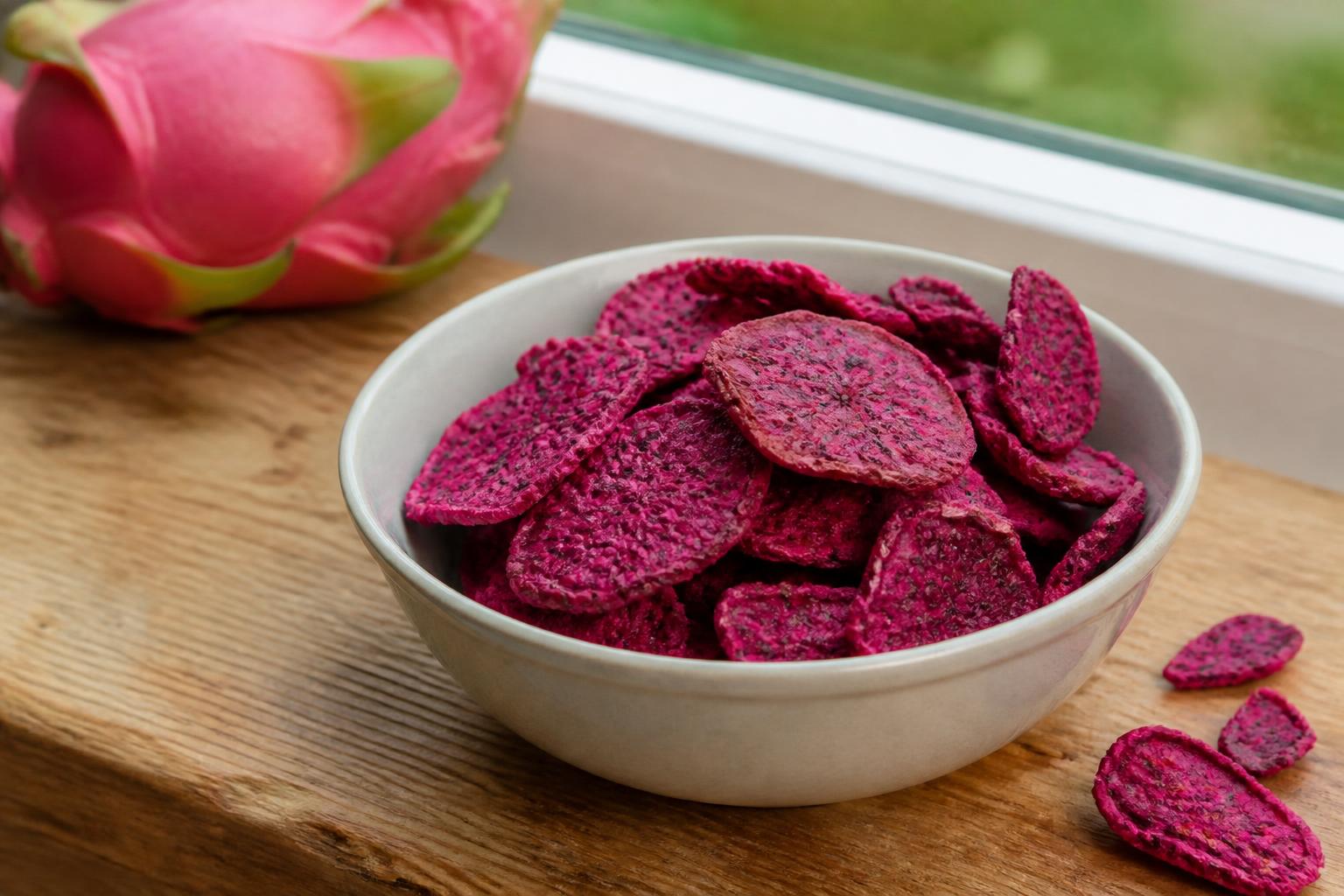
Dragon fruit that has been freeze-dried is simply fresh dragon fruit with the water removed in a way that keeps much of the fruit’s shape, colour and flavour intact. Instead of ending up sticky or leathery, it turns light and crisp, which is why it works so well as a snack, topping or ingredient.
For everyday snacking, that is the key thing to know. Freeze dried dragon fruit is still fruit, but it behaves very differently from fresh fruit once the moisture is gone. It crunches, it keeps well in a sealed pack, and it can be used either as bite-sized pieces or crushed into a bright pink powder.
What freeze-dried dragon fruit actually is
Dragon fruit, also called pitaya, is a tropical fruit with vivid pink skin and either white or magenta flesh dotted with tiny black seeds. Fresh, it is mild, juicy and soft, with a clean sweetness that is usually less intense than mango or pineapple. If you have only ever seen it in smoothie bowls or fruit salads, freeze-dried versions can come as a surprise.
Freeze-drying is not the same as simply baking or dehydrating fruit. In plain English, the fruit is first frozen, then the ice inside it is removed under low pressure so it turns from solid ice into vapour without becoming liquid again. Because the water leaves in that controlled way, the fruit structure is left full of tiny gaps where the ice crystals used to be.
That is why the texture becomes crisp rather than chewy. With standard dried fruit, water is removed more slowly and usually with heat, so the fruit collapses into a denser, bendier texture. Think of raisins, dried apricots or mango strips. Freeze-dried fruit keeps a more open, airy structure, so when you bite into it, it snaps and crumbles instead of pulling back like a gummy sweet.
Dragon fruit is especially well suited to this because its fresh texture is already soft and full of water. Once that water has gone, what remains is delicate and brittle, with those little seeds adding a faint extra crunch. The result is a fruit snack that feels closer to a crisp than to traditional dried fruit.
How freeze-drying changes texture, flavour and shelf life
The first change is texture, and it is the one most people notice straight away. Good freeze-dried dragon fruit should feel dry to the touch and crisp when you bite it. Depending on the cut, you might get slices, cubes or shards. All should be light rather than dense. If a piece feels leathery, tacky or bendy, moisture has usually crept in.
The flavour changes too. Removing water does not magically create sugar, but it does concentrate what is already there. That means the taste can seem sweeter and more noticeable than in fresh dragon fruit, especially because there is no juicy dilution. At the same time, dragon fruit is naturally a fairly gentle fruit, so even freeze-dried versions are often subtler than freeze-dried strawberries or raspberries. Expect a clean fruity sweetness, a faint floral note in some varieties, and a dry melt as the pieces break down in the mouth.
Colour can be dramatic, particularly with red-fleshed dragon fruit. Freeze-dried pieces often look brilliantly pink or magenta, which makes them popular for toppings and baking. That visual impact is real, but it is worth remembering that appearance alone does not tell you whether the pack contains only fruit or includes extras.
Shelf life is where freeze-drying really earns its keep. Microbes and moulds need moisture to grow, and crisp freeze-dried fruit contains very little available water. As long as the product stays sealed and dry, it tends to keep well in ambient storage. That does not mean it lasts forever, and it does not mean every pack has the same durability, but it does explain why it can sit happily in a cupboard rather than the fridge.
Packaging matters here. A proper moisture barrier, often a foil-lined pouch or a well-sealed tub, helps keep the fruit crisp. Once the seal is broken, the product starts pulling moisture from the air, especially in a steamy kitchen or on a humid day. That is when crisp can turn to soft surprisingly quickly.
If you enjoy crunchy snacks more broadly, the same principle comes up in our guide to how crunchy snacks fit into everyday eating. Texture is not a small detail, it often decides whether a snack gets eaten at all.
Is freeze-dried dragon fruit healthy?
In broad terms, freeze-dried dragon fruit can be part of a healthy diet, but it is still worth keeping your feet on the ground. It is fruit, and if the ingredient list is just dragon fruit, you are getting fruit in a shelf-stable, crunchy format. What you are not getting is the water content that fresh fruit provides, and that changes both portion size and eating experience.
Because the water has been removed, a small handful can represent more fruit than it looks like. That is not a problem in itself, but it does mean it is easy to eat quickly. A bowl of fresh fruit slows you down because of the volume and juiciness. A pouch of freeze-dried fruit is lighter, faster and more concentrated.
Nutritionally, freeze-drying can help preserve many of the fruit’s characteristics better than harsher drying methods, but it is not sensible to make sweeping claims that one freeze-dried fruit is a miracle food. The exact nutrient profile depends on the fruit variety, the ripeness at harvest, the processing method and the serving size declared on the pack. If you want a grounded look at the wider category, our piece on whether freeze-dried fruit is a healthy snack choice breaks down the trade-offs without the halo.
It is also worth separating “contains fruit” from “counts exactly the same as fresh in every way”. In UK dietary advice, whole fruit is encouraged, but practical life includes convenience foods too. Freeze-dried fruit can help people eat more fruit in situations where fresh is awkward, messy or short-lived. That is useful. It does not mean we should pretend a crunchy fruit topper and a whole fresh fruit are identical experiences.
Health claims on packaging are another area to approach with a clear head. In the UK, nutrition and health claims are controlled, and businesses cannot just make up medical-style promises. If a pack implies benefits beyond what the label can properly support, that is a reason to pause. “Source of fibre” or “high in vitamin C” have specific conditions. “Boosts immunity” or “detoxes the body” are a different matter and should not be treated casually.
So yes, freeze dried dragon fruit can fit neatly into a balanced routine, especially if you like fruit but want something portable and crisp. Just keep portions in view and judge the product by the actual label, not by the glow that surrounds anything sold in a pastel pouch.
What to check on the label before you buy
Start with the ingredients list. If you want the simplest version, look for one ingredient only, dragon fruit. In UK labelling, ingredients are listed in descending order by weight, so if sugar, syrup or flavourings appear, you will see them there. Some products are genuinely just fruit. Others are sweetened, flavoured or blended with other ingredients.
Next, check the nutrition panel per 100g and per serving, if both are given. Per 100g lets you compare products properly. Per serving tells you what the manufacturer considers a portion, but serving sizes can be surprisingly small, so do not assume the whole pack equals one serving unless the label says so.
Sugar is the big one many shoppers scan first. With fruit, some sugar will be naturally occurring. The label may not always separate naturally occurring sugars from added sugars in the main nutrition box, which is why the ingredients list matters so much. “100% fruit” tells a different story from fruit with added cane sugar or fruit juice concentrate.
Look out for flavourings and colourings too. Dragon fruit has striking natural colour, especially the red-fleshed type, so a vivid appearance does not automatically mean anything artificial has been added. Still, if you are buying it because you want a straightforward fruit snack, it is worth checking.
Allergen information is less dramatic here than with many savoury snacks, but cross-contamination statements can still matter if the product is packed in a facility that handles nuts, milk or cereals containing gluten. Read the “may contain” wording if allergies are relevant in your household.
Country of origin can also be useful. It will not tell you whether the product tastes better, but some shoppers prefer to know where the fruit was grown and where it was packed. If a label gives both, even better.
Finally, do not ignore the pack size. A tiny resealable pouch and a large catering-style bag suit different uses. If you are buying for lunchboxes or desk snacks, portion control and resealability matter. If you are buying for smoothie bowls, baking or yoghurt toppers, a larger pack may make more sense.
If you are trying to compare snack formats without getting carried away by “healthy” branding, our article on freeze-dried fruit in the UK without the health halo is a useful companion.
Easy ways to use it in everyday food
This is where freeze-dried dragon fruit comes into its own. Because it is crisp and dry, it behaves differently from fresh fruit and from chewy dried fruit, so the best uses play to those strengths.
For breakfast, scatter whole pieces over Greek yoghurt, skyr or porridge just before eating. Add them too early and they start softening as they absorb moisture. If you want that contrast between creamy and crisp, timing matters. The same goes for overnight oats. Stir them through at the last minute, not the night before.
On cereal or granola, keep the pieces fairly large. Smaller crumbs can sink and disappear, while larger shards give you those bright pops of colour and crunch. Mixed with nuts and seeds, dragon fruit pieces can lighten a homemade snack mix that might otherwise feel heavy.
For lunchboxes and desk drawers, it works well as a neat fruit snack because there is no peeling, slicing or refrigeration. Just remember that the product is fragile. If the pack gets crushed at the bottom of a tote bag, you may end up with dragon fruit dust, which is not a tragedy, but it is a different use case.
That powder, in fairness, is extremely handy. Crushed freeze-dried dragon fruit can be stirred into yoghurt, folded into icing, whisked into milkshakes, or used to tint bakes and desserts naturally. If your goal is flavour and colour distributed evenly, powder makes more sense than whole pieces. We cover that in more detail in our guide to how freeze dried fruit powder fits into everyday snacks.
In baking, use whole or broken pieces where you want visible bursts of fruit, such as on top of muffins, traybakes or white chocolate bark. Use powder where you want a smooth finish, such as buttercream, meringue, cheesecake topping or pancake batter. Because the fruit is dry, it will not add the same moisture as fresh fruit, which can be an advantage when you want colour without making a mixture wet.
For smoothies, there are two routes. Add pieces directly if you are blending anyway, or use powder for a faster mix and a stronger visual effect. Freeze-dried fruit is not a replacement for frozen fruit if you want bulk and chill, but it can sharpen flavour and colour without watering things down.
And for simple snacking, pair it with ingredients that balance its airy crispness. Think roasted nuts, pumpkin seeds, a few dark chocolate buttons, or a spoonful over cottage cheese. It also works surprisingly well as a garnish on fruit salads where you want contrast rather than more softness.
How to store it so it stays crisp
The enemy is moisture. Once opened, freeze-dried dragon fruit starts attracting water from the air, and that is what changes the texture from crisp to soft. In most cases, a loss of crunch is about storage, not spoilage.
If the original pack is resealable, press out excess air and seal it firmly after each use. If it is not, transfer the contents to an airtight container straight away. A small jar with a tight-fitting lid or a clip-top container works well, provided it is completely dry before use.
Store it in a cool, dry cupboard, away from the kettle, hob and dishwasher. Those spots create bursts of steam, and steam is exactly what you do not want near freeze-dried fruit. The fridge is usually not the best place once opened because condensation can become an issue, especially when the pack comes in and out.
Use clean, dry hands or a dry spoon when taking pieces out. A damp spoon dropped into the bag can undo the whole point of freeze-drying. The same goes for sprinkling over yoghurt and then rolling the top of the bag closed with sticky fingers.
How can you tell the difference between texture change and actual spoilage? Softness alone is not a reliable sign that the fruit has gone off. It often just means moisture has got in. What matters more is any sign of visible mould, an obviously off smell, or evidence that the pack was compromised for a long time. Always follow the best before date and any storage instructions on the label, but use common sense too.
If a once-crisp pack has gone a bit soft but still smells and looks normal, it may still be perfectly usable in places where crunch does not matter, such as blitzed into powder, stirred into porridge, or blended into a smoothie. It is less satisfying as a snack, but not automatically wasted.
That, really, is the everyday story of freeze dried dragon fruit. It is fruit made crisp by careful drying, easy to keep in the cupboard, and versatile enough to move from snack pouch to breakfast bowl to baking tin. Buy the version with the label you actually want, store it away from moisture, and it does exactly what people hope it will do, add colour, crunch and a bit of fun without much fuss.

Questions about this article or a correction to suggest? Get in touch. Read more about our editorial approach.